EAS Security
 EAS Gate
 Security Tag
 EAS Accessories
 Gadgets
 Convex Mirror
 Road Barrier
 Burglar Alarm
 Calling System
Coordinating Leave Across Departments and Branches with eHajira
November 06, 2026

Coordinating Leave Across Departments and Branches with eHajira
A leave request affects more than the employee who submits it. A sales team may need someone to cover customer enquiries, a warehouse may need a qualified replacement, and a finance department may need to rearrange responsibilities before a reporting deadline. When employees work across several branches, these decisions become harder to coordinate through separate messages and spreadsheets.
The challenge is to support employees’ leave arrangements while keeping responsibilities clear. Managers need to understand who will be away, which work needs a handover and whether another department or location will be affected.
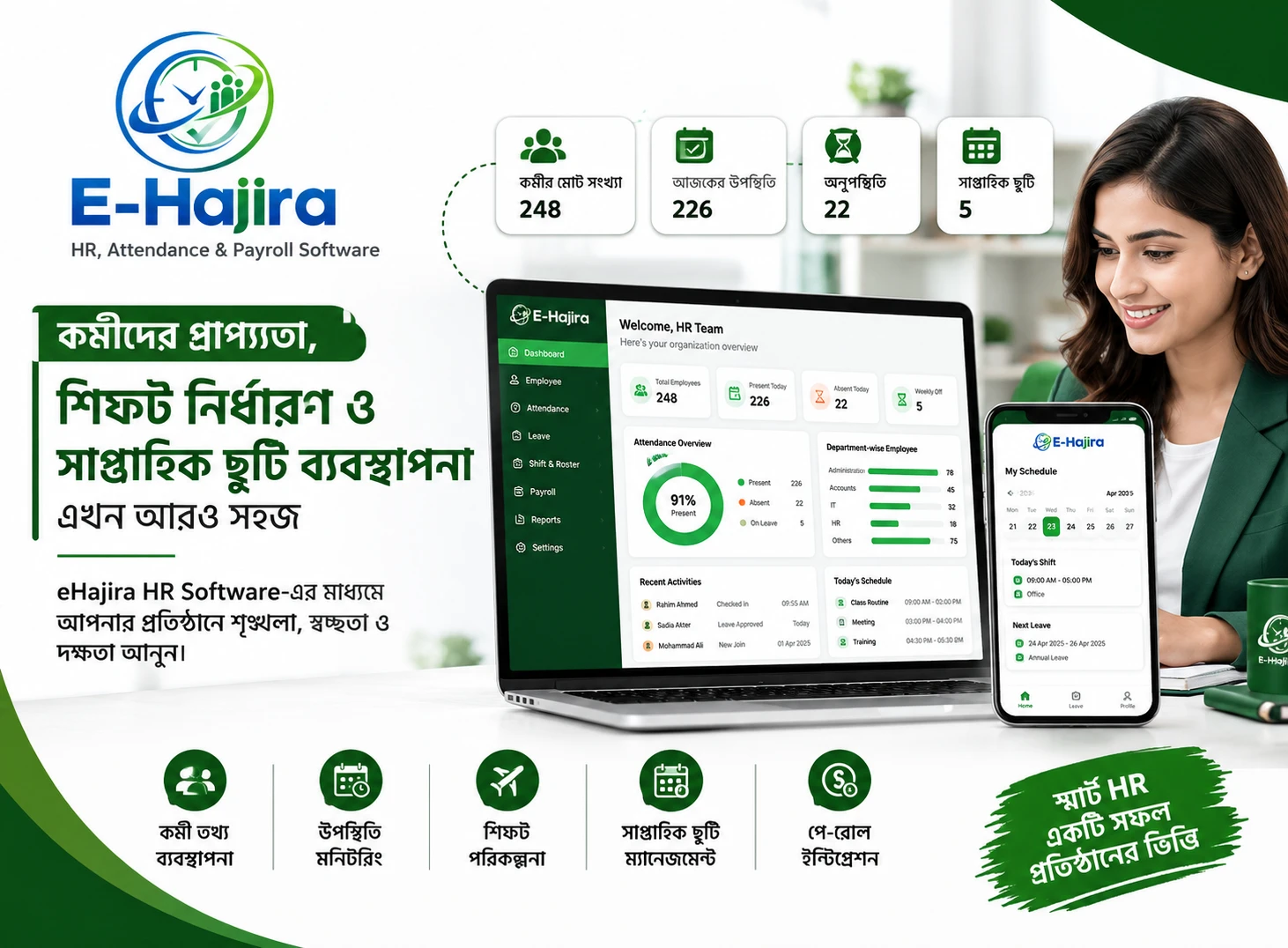
eHajira’s published information describes online leave requests, approval-status tracking, leave balances, departmental records and multi-branch administration. These capabilities can provide useful information for a coordinated leave-management process. Institutions should confirm the features and access controls included in their selected package.
This guide explains how Bangladesh businesses can organise leave planning around eHajira, connecting employee requests with practical team coordination.
What Is Department-Wise Leave Calendar Management?
Department-wise leave calendar management means organising leave information so that managers can understand planned absences within a team and their effect on connected operations.
The word “calendar” describes the planning perspective. It does not necessarily mean that every software implementation includes an interactive monthly calendar. A filtered leave list or an approved planning document can also help staff review absences by date.
The important relationship is between an employee, a department, a branch and an absence period. Managers should be able to distinguish confirmed leave from requests still awaiting a decision.
A useful process makes these distinctions visible without exposing unnecessary personal information.
How eHajira Supports the Planning Context
eHajira’s documented leave functions provide a starting point for organising requests and their status. Its employee and organisational records can help establish where each person belongs.
However, businesses should verify whether their deployment includes a department-filtered calendar, overlapping-request warnings or a direct comparison with shift coverage. The public information reviewed for this guide does not establish every one of these functions.
This article therefore presents an administrative workflow for businesses using eHajira. It distinguishes supported leave-management areas from additional requirements that need demonstration.
Where a particular calendar or control is unavailable, the organisation can use a governed supporting process while retaining a clear source for approved leave records.
Why Coordination Matters for Bangladesh Businesses
A business in Bangladesh may have a head office in Dhaka, regional sales locations and a warehouse serving several branches. Employees at these workplaces can depend on one another even when they belong to different departments.
A branch administrator may rely on the central finance team for payment processing. A service team may need technical support from another location. If leave is reviewed only within individual teams, a shared dependency can be overlooked.
These are practical examples rather than findings about every employer in Bangladesh. Each organisation should identify its own critical relationships.
Coordinated planning helps managers discuss those relationships before an absence begins, allowing work to be reassigned or rescheduled with clearer expectations.
Begin with Accurate Department and Branch Records
Leave planning depends on knowing where employees currently work and who is responsible for reviewing their requests.
An employee may retain an old department assignment after a transfer. A manager may change roles while the reporting relationship remains outdated. These errors can send information to the wrong reviewer or make a team appear more available than it is.
HR should establish a reliable employee structure before introducing a broader planning process.
The organisation also needs to distinguish a permanent assignment from temporary support at another branch. A short visit should not automatically rewrite the employee’s permanent organisational history.
Define Leave Categories Clearly
Employees and managers should understand what each available leave category represents and which process applies.
Different categories may require different information or handling. Planned annual leave, an unexpected illness and another authorised absence should not be forced into identical administrative assumptions.
HR should configure the categories according to the organisation’s verified requirements. This guide does not prescribe Bangladesh leave entitlements, statutory durations or documentation rules.
The objective is clarity. Employees should not choose an inaccurate category simply because it is the only option they recognise, and managers should not infer an entitlement decision solely from a category’s label.
Separate Entitlement from Operational Planning
Leave entitlement and work coverage are related administrative concerns, but they are not the same decision.
HR needs to consider the applicable employment arrangements and requirements. Managers need to identify what work will be affected and how responsibilities can be covered.
A staffing concern should prompt appropriate planning rather than an unsupported assumption that an employee cannot take leave. Equally, a visible balance does not explain every procedural requirement associated with a particular request.
The organisation should define how these questions are reviewed together. eHajira can support records and workflow, but management remains responsible for applying the correct policy and handling requests appropriately.
Distinguish Pending and Approved Requests
A request awaiting review should not be displayed or discussed as though the employee’s absence has already been confirmed.
Managers may want to consider pending requests when planning ahead, but they need to understand the difference between possible and approved absence.
The same clarity is necessary for rejected, cancelled or revised requests. Otherwise, an old entry may continue to influence staffing decisions after the underlying situation has changed.
Staff should confirm how these statuses appear in their eHajira setup. If a supporting planning document is used, it should be updated from the authorised record rather than maintained independently without reconciliation.
Review Work Requirements before Counting People
A department may have enough employees present but still lack someone who can perform an essential task.
For example, a team of six may depend on two people with a particular technical skill. If both are away, the remaining headcount does not describe the full operational impact.
Managers should identify the responsibilities required during the absence period. They can then consider trained substitutes, adjusted deadlines or support from another team.
This review should avoid treating employees as interchangeable. A practical coverage arrangement depends on competence, authority and workload as well as the number of people available.
Consider Shifts and Non-Working Days
A date-based leave view can be misleading if it is interpreted without the employee’s working schedule.
Someone who is not on leave may still be unavailable because they are off duty. A night-shift employee may have working time that crosses two calendar dates.
Managers should therefore compare planned leave with the relevant roster and working arrangements. HR should also confirm how holidays and non-working days affect leave calculations under the applicable rules.
Where eHajira is expected to calculate these relationships, test the actual behaviour. A calendar display alone does not establish that every schedule-specific calculation has been configured correctly.
Coordinate Dependencies between Departments
Some absences affect work outside the employee’s own department. A finance officer’s leave may affect a branch waiting for an authorised transaction, while a warehouse supervisor’s absence may affect dispatch arrangements.
The manager reviewing the request should identify these dependencies early. The affected team does not necessarily need personal details about the absence; it needs to know how the work will continue.
A concise handover arrangement can identify the substitute contact and any changed deadlines.
This coordination helps prevent a leave decision from becoming an unexpected interruption for another department that had no visibility of the operational change.
Plan Support between Branches Carefully
Support from another branch may be useful, but it should not be assumed to be immediately available.
The receiving manager should confirm what help is needed. The original manager should assess whether releasing the employee will create another gap.
Travel, equipment, system access and working hours also matter. An employee who can assist remotely may not need to move physically, while another task may require on-site presence.
Leave planning should therefore connect with a realistic support arrangement. Moving an employee’s name on a document is not enough to establish that the intended coverage will work.
An Illustrative Coordination Scenario
Consider a company with customer-service teams in Uttara and Chattogram. An Uttara supervisor submits a planned leave request for a period that includes an important service review.
The branch manager checks which responsibilities require a substitute. HR reviews the request through the applicable process, while the manager confirms whether another trained employee can lead the review.
A Chattogram colleague may provide remote support, but their own workload and schedule need confirmation first.
Once the arrangement is approved, the team receives a clear substitute contact and handover instructions. This is an illustrative management process, not a claim that eHajira automatically selects a replacement or calculates coverage.
Establish Clear Approval Responsibilities
Employees should know who reviews a request and how they will receive the decision.
A process becomes confusing when a line manager believes HR is responsible while HR is waiting for the manager’s recommendation.
Selected eHajira product information advertises multi-level approval workflows. Businesses requiring this arrangement should demonstrate the exact sequence, permissions and final status in their proposed deployment.
The organisation should also define who resolves an incorrectly routed request. Technical routing supports the process, but it does not replace a clear allocation of responsibility.
Prepare for an Approver’s Absence
The person responsible for approving leave may also be unavailable. Without an agreed arrangement, requests can remain pending longer than necessary.
Management should designate an authorised alternative and establish how that person receives the information needed for a decision.
Temporary delegation should not be assumed to be a native software function. If it is required, verify how it works and whether the original approver’s authority changes during the delegation period.
Where the feature is unavailable, an approved alternative process can be documented. The employee should still receive an understandable decision rather than conflicting instructions from several people.
Make Handover Part of the Preparation
For planned leave, a practical handover explains what needs attention while the employee is away.
It should identify outstanding work, relevant deadlines and the person responsible for follow-up. The substitute also needs appropriate access and enough context to perform the task.
A handover should not become a reason to share passwords or distribute confidential files without control. Access should follow the organisation’s established arrangements.
The manager should confirm that the substitute understands the responsibility. A document being sent is not necessarily evidence that the work has been accepted or that the recipient has capacity to complete it.
Handle Unexpected Absences without Forcing a Planned Process
Not every absence can be arranged in advance. An employee may become ill or face an urgent situation.
The organisation should provide a practical notification route and explain how records can be completed when appropriate. Immediate operational support and later administrative verification may need separate handling.
Managers should avoid expecting the same preparation from an unexpected absence as from planned leave.
The relevant information should still reach HR and the appropriate supervisor. A clear exception process helps maintain accurate records while recognising that employees may not always be able to complete normal steps immediately.
Update Plans when Leave Changes
An approved request may later be shortened, extended or cancelled. The planning record needs to reflect the authorised outcome.
Otherwise, a manager may arrange unnecessary cover or assume that someone has returned when an extension remains under review.
The organisation should define who approves the change and how affected teams are informed. Employees also need confirmation that the revised request has been recorded.
If eHajira is expected to recalculate balances or update connected information automatically, demonstrate these behaviours. Staff should understand the difference between submitting a change and having that change approved.
Protect Sensitive Leave Information
A shared planning view should provide enough information for coordination without revealing unnecessary personal details.
A colleague may need to know that an employee is unavailable and whom to contact. They may not need the reason, supporting documents or medical information.
HR should define access according to responsibility. The available permissions should be tested using representative employee and manager accounts.
The same care applies to exported files and screenshots. Information that is appropriately restricted within software can become widely exposed if someone forwards a detailed leave report to an unrelated group.
Reconcile Leave with Attendance and Payroll
Approved leave should be considered when reviewing attendance records. Otherwise, an authorised absence may appear unresolved.
However, the payroll treatment of leave depends on the relevant category and applicable arrangements. Managers should not infer a financial outcome merely because an employee is away.
Before monthly attendance is finalised, HR should review pending changes and mismatched records. This includes cancelled leave, incomplete requests and attendance recorded during a previously approved absence.
The organisation should test how its eHajira configuration connects these areas. Any discrepancy should be investigated before it influences salary preparation.
Review Planning Quality over Time
Useful measures include how long requests remain pending, how often coverage arrangements change unexpectedly and whether employees understand the process.
A department receiving many last-minute requests may need clearer communication, but the numbers require context. Unexpected personal circumstances and different work patterns can affect the pattern.
Managers should also review whether the same employees repeatedly provide cover and whether that creates an unreasonable workload.
The purpose is to improve coordination rather than rank departments according to how little leave employees take. A reliable process should support appropriate leave administration and sustainable work arrangements.
Start with a Limited Pilot
A pilot involving two departments or branches can reveal gaps before the process expands.
Test a planned request, an overlapping request and a change after approval. Confirm what the employee sees, what the manager can access and how HR identifies the final status.
The team should also test the supporting coverage process. A technically successful request does not prove that the substitute received the necessary instructions.
After the pilot, revise configuration and staff guidance where needed. This provides a more dependable foundation than introducing an organisation-wide calendar without confirming how people will use it.
Frequently Asked Questions
1. What does department-wise leave coordination mean?
It means reviewing employee absences in relation to departmental responsibilities and connected operations. The process helps managers plan handovers and communicate who will cover important work.
2. How can eHajira support leave administration?
Its published information describes online requests, status tracking and leave balances. Businesses should confirm the relevant functions, configuration and access controls in their selected deployment.
3. Does eHajira include an interactive leave calendar?
That specific display should be demonstrated. The sources reviewed do not establish that every package includes a department-filtered interactive calendar.
4. Can several branches be considered together?
A coordinated process can consider information across branches. The organisation should verify the available branch views and permissions before relying on a particular screen or report.
5. Should pending requests count as confirmed absence?
No. Managers can consider them for advance planning, but they should remain distinguishable from approved leave.
6. Is leave balance enough to make a decision?
A balance is one relevant input. The appropriate request process and applicable requirements still need to be considered.
7. Should managers review headcount alone?
No. Skills, authority and workload matter too. A team can have several people present while lacking someone able to perform an essential responsibility.
8. How do shifts affect leave planning?
An employee who is not on leave may still be off duty. Managers should consider the roster rather than treat every available calendar date as working time.
9. Can another branch provide a replacement?
Potentially, if the person is suitable and available. Both branches should confirm the arrangement and consider travel, workload and access requirements.
10. Does eHajira automatically select replacement staff?
This capability was not confirmed in the reviewed sources. Businesses should treat replacement selection as a management decision unless the required function is demonstrated.
11. Who should approve leave?
The organisation should define the authorised sequence. Employees, managers and HR need a shared understanding of who makes the final decision.
12. Are multi-level approvals available?
Selected product information advertises them. The required number of stages, permissions and routing should be confirmed for the chosen package.
13. What happens when the approver is away?
An authorised alternative should be established. Temporary software delegation, if required, needs separate verification.
14. What should a handover contain?
It should explain outstanding responsibilities, deadlines and substitute contacts. Sensitive information and access should remain controlled.
15. How should unexpected absence be handled?
Provide a practical notification route and follow the relevant process. Operational cover may need to be arranged before the employee can complete normal administrative steps.
16. What if approved leave is cancelled?
The authorised record and any coverage arrangement should be updated. Staff should confirm whether related balances and attendance information also require review.
17. Should colleagues see the reason for leave?
Usually, operational coordination requires availability information rather than detailed personal reasons. Access should reflect legitimate responsibilities.
18. Can approved leave affect payroll?
The treatment depends on the applicable category and arrangements. HR should verify the record and configuration before it influences salary preparation.
19. Does submitting a change mean it is approved?
No. Submission and approval are different stages. Employees and managers should check the final authorised status.
20. What should businesses test in a demonstration?
Test overlapping requests, approval routing, branch visibility, cancellation and the employee experience. These scenarios reveal whether the proposed setup fits actual operations.
21. What is the best starting point?
Begin with accurate organisational records and a limited pilot. Define responsibilities, test exceptions and expand after the process is understood.
Build a Clear Connection between Leave and Team Planning
Coordinating leave across departments and branches requires reliable records and clear responsibilities. Employees need an understandable request process, while managers need enough information to organise work without exposing unnecessary personal details.
For Bangladesh businesses using eHajira, the practical approach is to verify the available functions and connect them with a realistic handover and coverage process. A small pilot can establish how requests, decisions and later changes will be handled.
To discuss your organisation’s leave-management requirements, contact 01853330354 / 01853330347 and request an eHajira demonstration based on your departments and branch structure.
Recent Post