EAS Security
 EAS Gate
 Security Tag
 EAS Accessories
 Gadgets
 Convex Mirror
 Road Barrier
 Burglar Alarm
 Calling System
Reviewing Hostel Information for Residential Qawmi Madrasas in eBiddyaPro
November 15, 2026

Reviewing Hostel Information for Residential Qawmi Madrasas in eBiddyaPro
When a guardian contacts a residential Qawmi madrasa, a straightforward question can expose a difficult administrative problem: who is responsible for the hostel, and which telephone number should the guardian use? If the answer depends on finding an old notebook or asking several employees, the institution has an information management gap.
Residential administration involves more than maintaining a list of buildings. Administrators need clear institutional identities, accurate branch information, current supervisory contacts, and dependable records of operational status. When these details become outdated, routine communication becomes slower and responsibilities become harder to establish.
For Qawmi madrasas in Bangladesh, eBiddyaPro offers a platform to evaluate for organizing these administrative records. Its suitability should be assessed against the madrasa’s actual residential arrangements, available modules, and staff responsibilities.
This guide explains how to review hostel information using the fields visible in the supplied eBiddyaPro interface. It also identifies related residential management requirements that should be demonstrated separately before an institution assumes they are supported.
Understanding the Evidence Behind This Guide
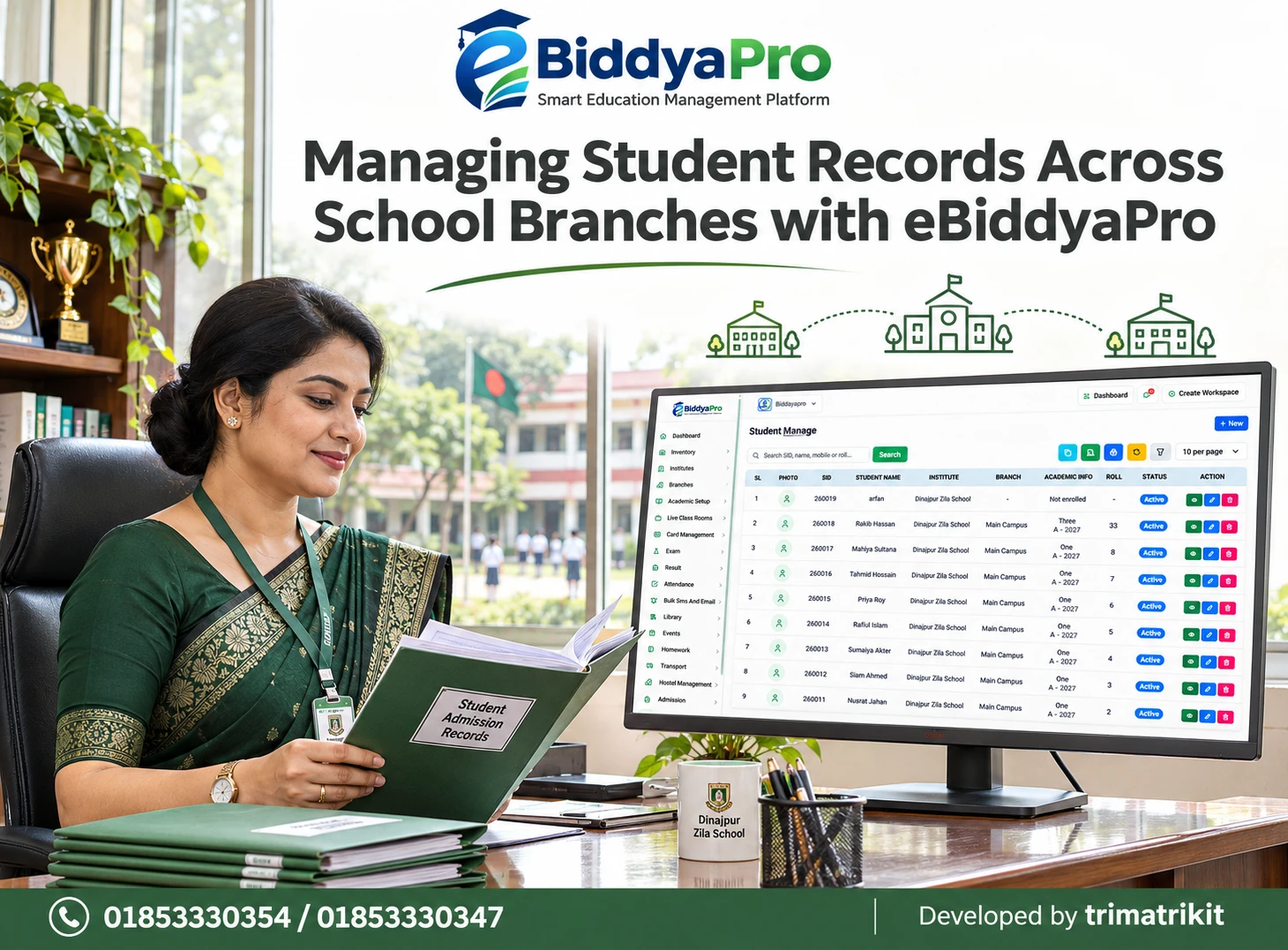
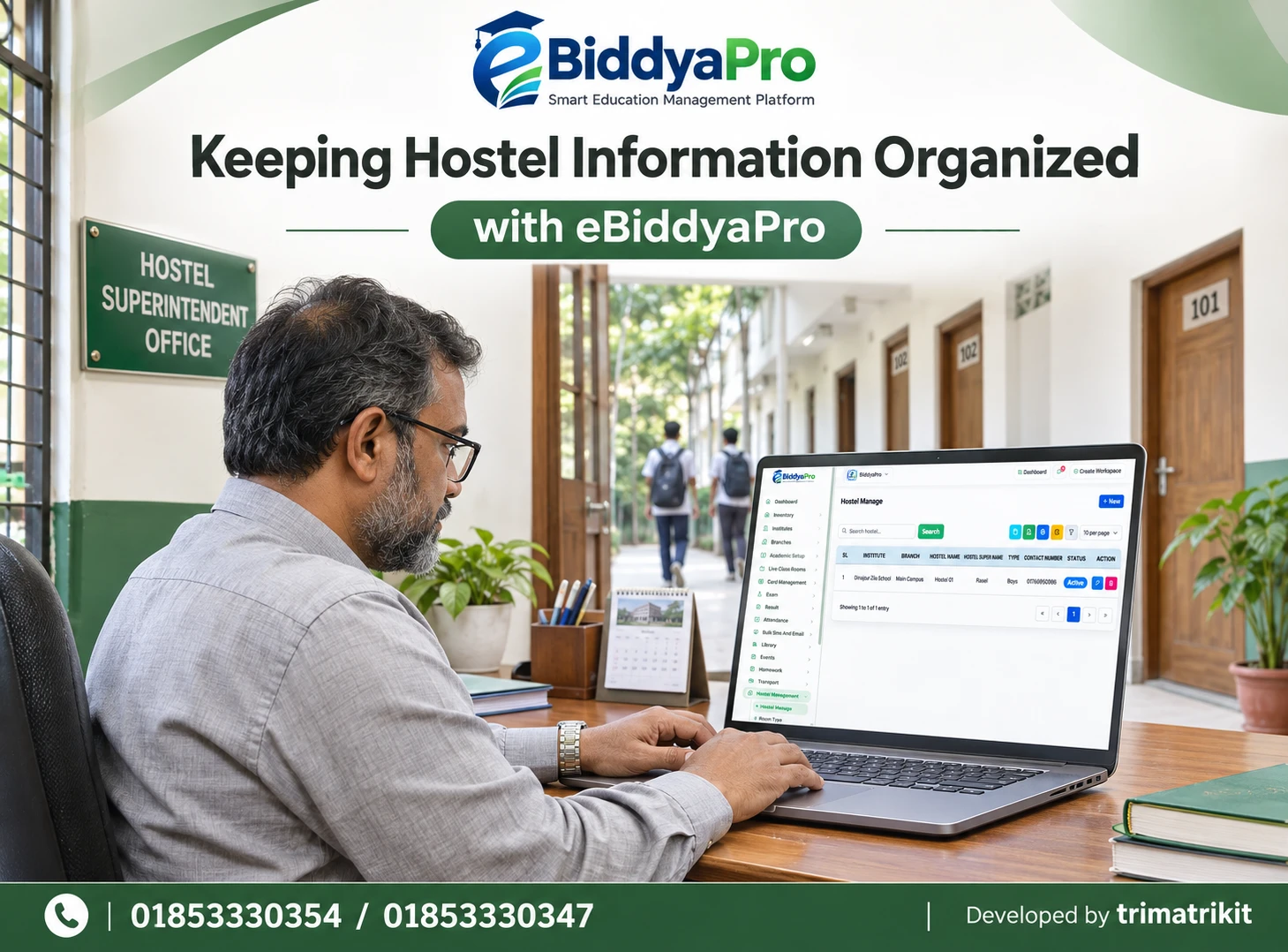
The supplied eBiddyaPro Hostel Manage screen displays columns for Institute, Branch, Hostel Name, Hostel Super Name, Type, Contact Number, Status, and Action. It also shows a search field, a New button, pagination controls, and edit and delete icons.
These visible elements support a practical discussion about maintaining a hostel directory. They do not establish how student allocation, room capacity, residential attendance, fee calculation, or historical changes work.
The supplier’s published eBiddyaPro guide discusses hostel management as relevant to institutions providing accommodation. Importantly, it describes room allocation, resident records, accommodation fees, and occupancy reports as potential requirements to evaluate. Those descriptions should guide a demonstration rather than be treated as confirmation that every function is included in every package.
The recommendations below are administrative guidance based on these observations. They are not findings from a survey of Qawmi madrasas or a claim that the software has been independently audited.
Why Hostel Information Matters in Bangladesh’s Qawmi Madrasa Context
A residential Qawmi madrasa may accommodate learners from different districts, operate more than one residential building, or share administrative responsibilities among several people. These arrangements differ between institutions, so the software structure should reflect the actual organization.
An institution might use a familiar local name for a hostel while its formal records use another name. Similarly, a supervisor may change duties while an older contact list remains in circulation. Both situations can make an otherwise simple enquiry unnecessarily complicated.
A consistent digital directory can provide a shared reference for authorized employees. Its value comes from keeping the information dependable and accessible to the appropriate people. Software cannot resolve unclear responsibilities unless the institution first decides who owns each responsibility.
Start with the Correct Institute
The Institute field establishes which institution owns or administers the hostel record. This matters when one administrative setup contains several institutions with similar names.
Before creating or editing a record, compare the selected institution with the madrasa’s approved identity. Avoid choosing an institution simply because it appears first or resembles the correct name.
The relationship should remain clear in any output used for administration. If a hostel list is exported or printed, recipients should be able to understand which institution each record belongs to.
Where English, Bengali, or Arabic versions of an institution’s name are used, establish an approved naming convention. Consistent identity information makes searching and reconciliation easier, particularly when several employees enter records.
Review the Branch Separately from the Institution
Institute and Branch are separate columns in the supplied interface. Administrators should preserve that distinction.
A madrasa may operate a main campus and another teaching or residential location. A hostel serving one branch should not be assigned to another simply because both belong to the same institution.
Review branch information whenever a building changes administrative responsibility or a campus arrangement changes. A physical building can remain in the same location while its administrative relationship changes.
Do not assume that changing the branch field transfers residents, fees, or other linked information. That behavior is not established by the list screen. If such transfers are required, request a demonstration of the complete process and its effect on existing records.
Give Each Hostel a Clear, Consistent Name
Names such as “Hostel 01” can be useful, but only when employees understand which building they identify. If several branches use identical hostel names, the institute and branch context becomes especially important.
Choose a naming convention that works in everyday conversation and formal records. An institution might use a building name, an internal code, or a consistent combination of both.
Avoid creating multiple records for the same hostel under slightly different spellings. Duplicate records can make supervision and communication appear divided when the physical facility is actually the same.
Before adding a new hostel, search for existing entries. Where the search scope is unclear, test it with known records rather than assuming it searches every field or every branch.
Confirm Who the Hostel Super Name Represents
The Hostel Super Name field is useful only if its meaning is understood. The named person might be the formally appointed superintendent, the current administrative contact, or another designated supervisor. The institution should decide which interpretation applies.
Confirm the person’s current responsibility before updating the field. A person who previously supervised the hostel may still work at the madrasa but no longer be the appropriate contact.
The visible list does not prove that the supervisor’s name links to an employee profile or that responsibility dates are recorded automatically. If linked employee records or appointment history are important, verify those capabilities separately.
A clear internal handover process remains necessary even when the current supervisor’s name is stored digitally.
Verify Contact Numbers Through Direct Confirmation
A contact number can look complete and still be incorrect. It may belong to a former supervisor, contain a typing error, or no longer be monitored for institutional communication.
Ask the designated contact to confirm the number before it becomes the shared reference. Where appropriate, make a test call and establish when the number is expected to be answered.
Phone numbers should retain their correct format, including a leading zero where applicable. If records are exported into spreadsheet software, check that formatting has not changed.
The supplied list shows one Contact Number column. It does not establish support for several emergency contacts or automatic routing. If alternative contacts are necessary, confirm the supported arrangement and maintain an approved fallback process.
Understand the Hostel Type Before Using It
The Type column shows how the hostel is categorized. In the supplied example, the value is “Boys.” That example does not reveal the complete set of available choices or their operational effects.
The selected type should match the institution’s actual accommodation arrangement. It should not be used as a substitute for identifying the branch, academic department, age group, or room category.
Administrators should also establish whether the type is merely descriptive or whether it affects other workflows. For example, the list alone does not prove that a type selection prevents an unsuitable student allocation.
Where eligibility rules are important, ask the supplier to demonstrate how those rules are enforced and what happens when an incorrect allocation is attempted.
Interpret Active Status Carefully
The Status column provides a quick indication of the record’s operational state. However, an Active label should not be interpreted as proof of occupancy, available capacity, safety approval, or readiness to accept new residents.
A hostel can be operational while some rooms are unavailable. Conversely, a temporarily unused building may still need to remain in the institution’s historical records.
Define how status should be used within your administrative process. Confirm whether changing it affects new selections, existing allocations, financial records, or reports.
The visible status label does not establish the underlying rules. Before changing a hostel’s status, determine the intended outcome and test the software’s actual behavior against that expectation.
Use Search to Reduce Repeated Manual Lookups
A searchable directory can reduce the need to consult several paper lists for basic hostel details. Staff can begin with a known hostel name and review the corresponding institutional and supervisory information.
However, search behavior should be tested. A field labeled “Search hostel” may not necessarily search supervisor names, contact numbers, or all records across every institution.
Pagination also matters. A short visible page is not always the complete dataset. Check the total record count and clear any active search before concluding that a hostel is missing.
These habits help administrators distinguish between a record that does not exist and a record hidden by the current view. That distinction prevents unnecessary duplicate entries.
Review Changes Before Editing a Hostel Record
An edit can affect more than the appearance of a row. Changing a name, branch, or supervisor may influence how other employees interpret the record.
Before editing, establish whether the change corrects an error or represents a real administrative event. Correcting a misspelled name is different from appointing a new supervisor.
If the software does not provide visible change history, maintain an approved record of significant decisions elsewhere. Do not assume that the previous value can always be recovered.
After saving, reopen or refresh the relevant view and confirm that the intended information appears. Where hostel details feed into other outputs, review a sample output as well.
Treat Deletion as a Separate Administrative Decision
The supplied interface includes a delete icon. Its presence does not explain whether deletion is permanent, reversible, or restricted when linked records exist.
Before removing a hostel, determine whether it has been used in resident assignments, financial records, or earlier reports. A duplicate test entry and a previously operational hostel require different decisions.
Ask how deletion affects linked data and whether a non-destructive closure or inactive state is supported. Avoid assuming that changing status and deleting a record produce the same result.
Only an authorized person should approve removal of a meaningful institutional record. Where the software’s behavior is unclear, resolve the uncertainty before making the change.
Distinguish a Hostel Directory from Resident Management
A hostel directory identifies facilities and responsible contacts. Resident management identifies who lives in those facilities and during which period.
The supplied Hostel Manage list does not display students, allocation dates, rooms, beds, or occupancy totals. It therefore cannot confirm the complete resident management workflow.
If your madrasa needs to track student residence, request a demonstration beginning with a student profile and continuing through allocation, movement, temporary absence, and final departure.
Academic enrollment and hostel residence should remain distinguishable. A student may continue studying while changing accommodation, or leave the hostel temporarily without leaving the madrasa. The system should support the distinctions your institution actually needs.
Keep Room Capacity and Occupancy Questions Separate
A hostel name alone does not establish how many residents it can accommodate. Similarly, the number of registered students does not necessarily equal the number currently staying overnight.
If capacity reporting is required, determine whether the setup records rooms, usable spaces, approved capacity, and periods of unavailability. Confirm how occupancy is calculated.
Avoid introducing figures that appear precise but lack a reliable source. For example, counting student profiles without checking allocation dates may overstate current occupancy.
The directory can help identify the responsible supervisor, but physical verification and the relevant resident records remain necessary for confirming current accommodation arrangements.
Separate Academic Attendance from Residential Presence
Classroom attendance and hostel presence answer different questions. A student may attend lessons but have permission to stay with family that evening. Another student may be in the hostel but unable to attend a lesson.
For that reason, a general student attendance module should not automatically be treated as a residential roll-call system.
If evening roll calls, departure permissions, or return records are required, demonstrate those workflows separately. Establish who confirms a student’s location and how unresolved differences are handled.
An absent classroom mark should not, by itself, be interpreted as proof that the student has left the hostel. Accurate administration depends on using each record for the purpose it can support.
Maintain Guardian Communication Without Overexposing Information
The supervisor’s contact details support communication, but they do not replace accurate guardian records. Each student should have a dependable connection to the appropriate guardian or authorized contact through the institution’s approved process.
Confirm who may receive information about a student. A caller knowing the hostel name is not sufficient evidence that they are entitled to personal details.
Where messaging tools are offered, establish whether messages are manual or automatic, which contact receives them, and whether delivery can be checked. Do not assume that storing a number automatically enables notifications.
For demonstrations and staff training, use fictional student information wherever possible. This allows workflows to be tested without unnecessarily circulating real residential details.
Connect Information Quality with Responsible Supervision
UNICEF Bangladesh identifies protection from violence, abuse, exploitation, and neglect as a central child protection priority. That broad context is relevant when institutions administer residential arrangements involving children. It does not constitute an endorsement of eBiddyaPro or an assessment of Qawmi madrasa hostels.
As an administrative recommendation, current responsibility and contact information should support prompt communication when a concern arises.
However, a digital directory cannot replace suitable supervision, safe facilities, trained personnel, or an effective response procedure. Staff must know what action to take and who has authority to act. Keeping a supervisor’s name current is one supporting element of that broader responsibility.
Review Accommodation Charges Separately from Hostel Identity
A hostel record and a financial charge serve different purposes. Naming a hostel does not establish which student owes an accommodation fee, how much is due, or whether payment has been received.
If residential charges are part of your proposed setup, ask to see fee assignment, partial payment, approved concessions, outstanding balances, and corrections using fictional examples.
Donation-funded accommodation may also require a different accounting approach from student fees. Do not assume that a general fee module provides donor accounting or restricted-fund reporting.
The accounts team should approve how opening balances and ongoing charges are handled. That decision should be based on the institution’s actual financial process rather than a convenient default in the software.
Assess Cost, Connectivity, and Support in Bangladesh
For a residential Qawmi madrasa, the relevant cost is the complete operational cost. This may include software access, configuration, data preparation, training, and support.
Request a written proposal that identifies the included hostel functions. A general platform subscription should not be interpreted as including every residential workflow.
Connectivity also deserves a practical test. Establish what staff can do during an internet interruption and how urgent contact information will remain available to authorized personnel. Cloud access alone does not confirm offline operation.
Training should reflect actual responsibilities. The person maintaining supervisor details may need different instruction from the person managing residents or accounts. Clear ownership helps prevent outdated information after implementation.
Introduce the Process with a Small, Verifiable Pilot
Begin with a manageable number of hostel records. Compare each entry with the institution’s approved records and obtain confirmation from the relevant supervisor.
Then test realistic changes. A useful pilot could include correcting a contact number, updating a supervisor, searching for a hostel, and checking what happens when an operational status changes.
If resident allocation is included, test it as a separate workflow. Use fictional students and confirm how movements and previous records are handled.
Measure the results through practical indicators such as the time required to locate a contact, the number of incomplete records, and the frequency of duplicate entries. These measures provide institution-specific evidence without relying on unsupported claims of guaranteed savings.
Frequently Asked Questions
1. What does the eBiddyaPro Hostel Manage screen show?
The supplied screen shows Institute, Branch, Hostel Name, Hostel Super Name, Type, Contact Number, Status, and Action. It supports reviewing basic hostel directory information. It does not, by itself, confirm resident allocation, room capacity, or accommodation accounting.
2. Can a residential Qawmi madrasa consider eBiddyaPro?
Yes, provided the proposed configuration fits its requirements. The institution should demonstrate its own hostel structure, responsibilities, and residential workflows before purchase. General education management features do not automatically establish suitability for every Qawmi-specific requirement.
3. Does the screen prove that full hostel automation is available?
No. A directory screen demonstrates only the information and controls it displays. Student allocation, residential attendance, fee rules, and historical reporting require separate evidence through a complete demonstration.
4. Why should institute and branch be reviewed separately?
They represent different administrative relationships. A hostel can belong to an institution while serving a particular branch. Keeping both accurate helps employees identify the correct location and responsible administration.
5. Can two branches use the same hostel name?
They may do so operationally, but the complete identity must remain clear. Use consistent naming and review institute and branch context together. Confirm whether the software applies any uniqueness restrictions before creating similar names.
6. Who should appear as the hostel superintendent?
The institution’s designated responsible person should appear, according to an agreed definition. Confirm that the appointment is current. Do not leave a former supervisor listed simply because that person still works at the madrasa.
7. How should a supervisor’s telephone number be checked?
Confirm it directly with the designated person and, where appropriate, test it through a call. Establish when it is monitored. A correctly formatted number is not proof that it remains the appropriate institutional contact.
8. Can several contact numbers be stored?
The supplied list displays one Contact Number column. It does not establish whether multiple contacts are supported in the underlying form. Request a demonstration if alternate or emergency contacts are required.
9. Does Active mean beds are available?
No. The label alone does not establish occupancy or capacity. Confirm its defined behavior in your setup and use appropriate resident and capacity records to determine whether accommodation is available.
10. What does the hostel Type field control?
The example shows a descriptive type, but its complete options and effects are not visible. Ask whether it only categorizes the hostel or also restricts other workflows. Do not assume automatic allocation controls.
11. Can the search field find supervisors?
That is not confirmed by the supplied screen. Test search using known hostel names and other values. Understanding the search scope helps avoid incorrect conclusions about missing records.
12. Should an old hostel record be deleted?
First establish whether it has linked residents, charges, or historical use. Confirm deletion behavior and available alternatives. A previously operational hostel should not be treated like an unused test entry.
13. Are previous supervisor details retained automatically?
The list does not establish automatic change history. Ask to see how earlier values and effective dates are recorded. If necessary, maintain an approved administrative handover record through another controlled process.
14. Does Hostel Manage show where every student lives?
Not in the supplied list. Resident allocation is a separate requirement. Request a demonstration showing how a student is assigned, moved, and removed from accommodation while preserving relevant records.
15. Is classroom attendance enough for hostel roll calls?
No. Academic attendance and residential presence serve different purposes. A student’s location outside teaching hours requires an appropriate residential process. Confirm whether the proposed software supports that process.
16. Can temporary home leave be recorded?
That capability is not established by the hostel directory. If needed, demonstrate departure authorization, expected return, actual return, and unresolved cases. Determine who maintains and reviews those records.
17. Will guardians automatically receive hostel messages?
Storing a contact number does not prove automatic messaging is enabled. Confirm the relevant module, recipient selection, delivery process, and any additional cost. Test the complete workflow before relying on it.
18. Can hostel fees be collected through eBiddyaPro?
Accommodation fee handling should be confirmed in the proposed package. Ask to see assignment, collection, concessions, and balances. A hostel identity record alone does not establish the financial workflow.
19. Can the software manage donations for residential students?
Do not assume this from general hostel or fee management descriptions. Donor records and purpose-specific funds may require additional accounting capabilities. Demonstrate the institution’s actual reporting requirements separately.
20. Will the system work without internet?
Offline operation must be confirmed. Ask what remains accessible during an interruption and how later updates are reconciled. Maintain an approved fallback for essential contact information where necessary.
21. How often should hostel details be reviewed?
Update records whenever responsibilities, contacts, branches, or operational arrangements change. A scheduled review can also identify overlooked errors. The review interval should reflect the institution’s size and rate of change.
22. What should a madrasa request during a demonstration?
Use fictional examples reflecting your institute, branches, hostels, and supervisory structure. Test record creation, search, edits, status behavior, and relevant outputs. Demonstrate resident and financial workflows separately if they are required.
Arrange a Demonstration Around Your Madrasa’s Residential Needs
A useful hostel directory should help authorized employees identify the correct facility, responsible supervisor, and dependable contact without repeated manual searching.
Start with accurate institute and branch relationships, consistent hostel names, and confirmed supervisory information. Then assess resident allocation, attendance, accommodation charges, and reporting according to the functions your institution actually needs.
For an eBiddyaPro demonstration focused on residential Qawmi madrasa administration in Bangladesh, contact 01853330354 / 01853330347 and request a walkthrough using your own hostel structure and fictional sample records.
Recent Post