.webp)
 EAS Security
EAS Security
.webp) EAS Gate
EAS Gate
.webp) Security Tag
Security Tag
.webp) EAS Accessories
EAS Accessories
.webp) Gadgets
Gadgets
.webp) Convex Mirror
Convex Mirror
.webp) Road Barrier
Road Barrier
.webp) Burglar Alarm
Burglar Alarm
.webp) Calling System
Calling System
VERBEX VT-UR8000 UHF 8-Channel Wireless Microphone System: Professional Wireless Audio - Powerful Performance
September 26, 2026
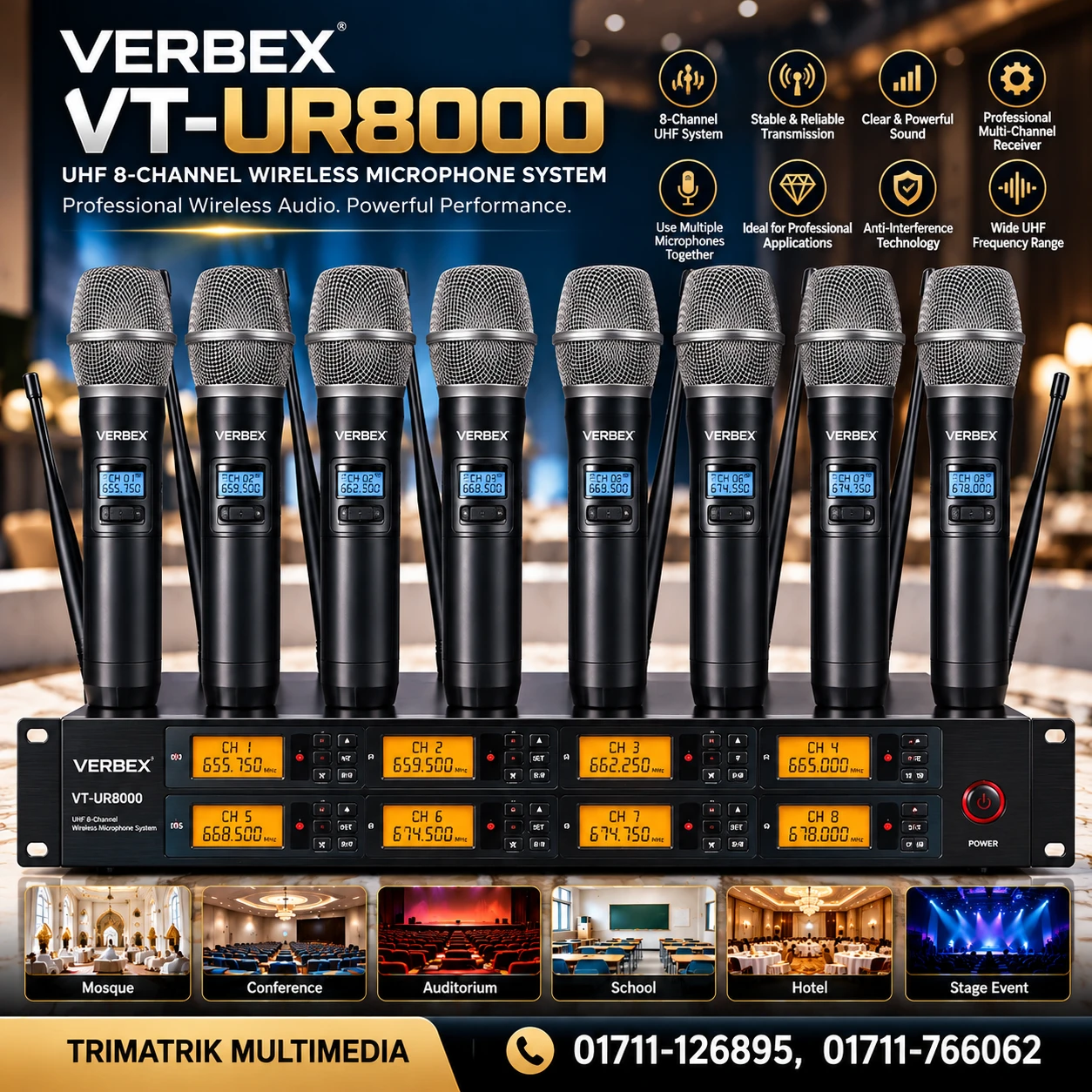
VERBEX VT-UR8000 UHF 8-Channel Wireless Microphone System: Professional Wireless Audio – Powerful Performance
In professional sound reinforcement, a microphone is more than a device for capturing a voice. In a conference hall, mosque, auditorium, educational institution, hotel, corporate meeting room, or live event, the microphone is the first link in the audio chain. When several speakers need to use microphones during the same program, the need for a dependable multi-channel wireless system becomes even more important.
The VERBEX VT-UR8000 UHF 8-Channel Wireless Microphone System is designed around this requirement: providing a practical professional wireless solution where multiple microphones need to operate together.
With eight handheld wireless microphones and a multi-channel receiver, the VT-UR8000 is positioned for installations and events that require flexibility, organized microphone management, and freedom from long microphone cables.
Its message is straightforward:
Professional Wireless Audio. Powerful Performance.
The Evolution of the Wireless Microphone
To understand why an eight-channel UHF system is useful today, it helps to look at how wireless microphones developed.
Before wireless systems, performers, presenters, broadcasters, lecturers, and public speakers were physically connected to their sound systems by microphone cables. Wired microphones remain extremely useful today, but cables naturally limit movement and can become difficult to manage when many microphones are used in the same space.
Engineers began experimenting with radio-based microphone transmission in the 1940s. Historical material from Shure notes early documented commercial wireless-microphone applications in a British ice show in 1947 and at a major-league baseball game in 1951.
A major milestone arrived in 1953 with the introduction of the Shure Vagabond 88, recognized by Shure as the first handheld wireless microphone system designed for performers. It combined a microphone and battery-powered radio transmitter in a portable handheld device.
By modern standards, the Vagabond was remarkably primitive. It operated around the 2 MHz band and used five subminiature vacuum tubes. Its transmitter weighed about one pound and measured roughly 12 inches long. Nevertheless, the underlying concept was revolutionary: capture a person's voice, transmit it without a physical microphone cable, receive the radio signal elsewhere, and feed the recovered audio into a PA or recording system.
That basic idea still sits at the heart of wireless microphone technology.
From Early Radio Microphones to Modern UHF Systems
Wireless microphones gradually became smaller, more practical, and more reliable as electronics evolved. Vacuum tubes gave way to transistors and integrated circuits. Battery technology improved. RF circuitry became more sophisticated. Receivers became more compact, and professional users gained access to selectable frequencies and multi-channel configurations.
Large concert stages and touring productions helped accelerate the modern wireless era during the 1970s, while more commercial wireless microphone systems became available in subsequent decades. Shure, for example, records the introduction of its own modern VHF wireless system in 1987.
Another important development was the widespread professional use of UHF—Ultra High Frequency—spectrum.
Wireless microphone spectrum rules differ by country, and users should always ensure that a system's operating frequencies comply with local regulations. The history of wireless microphone regulation also shows why frequency management matters: regulators have had to accommodate microphones alongside television, mobile broadband, and other radio services. For example, FCC records document wireless microphone operation across various VHF, UHF, ISM and other bands in the United States, with rules changing as portions of spectrum have been repurposed.
This evolution eventually produced the sophisticated multi-channel wireless systems familiar in professional audio today.
And that is the technological environment in which products such as the VERBEX VT-UR8000 belong.
Meet the VERBEX VT-UR8000
The VERBEX VT-UR8000 UHF 8-Channel Wireless Microphone System is designed for situations where a conventional one- or two-microphone wireless system simply isn't enough.
An eight-channel configuration makes it possible to equip several speakers with dedicated handheld microphones as part of one organized system.
Consider a conference panel with a moderator and several guests. A large meeting may involve multiple presenters. A school event may have teachers, students and administrators participating at different times. A religious or community program may involve several speakers. An auditorium event may require microphones to be distributed among presenters before the program starts.
In these environments, having multiple wireless microphones ready for use can simplify the workflow dramatically.
Instead of repeatedly passing one microphone between speakers or running numerous long audio cables across the room, the VT-UR8000 provides an integrated multi-microphone approach.
Eight Wireless Microphones, One Professional System
The central advantage of the VT-UR8000 is right in its name: 8-channel wireless operation.
Eight handheld microphones can provide significantly more flexibility than a conventional single- or dual-channel system.
For a panel discussion, microphones can be assigned to individual participants. During seminars, microphones can be prepared for different presenters. In larger events, several units can be positioned around the venue so staff do not need to continuously move one microphone from person to person.
This is particularly valuable when events have a strict schedule.
Every time someone has to locate a microphone, reconnect a cable, move equipment or hand a single microphone across a large stage, time is lost. A properly planned multi-channel wireless installation helps keep the program moving smoothly.
The result is not simply convenience. It can also contribute to a more professional event workflow.
Freedom From Microphone Cables
The original promise of the wireless microphone was freedom of movement. More than seven decades after pioneering systems appeared, that benefit remains just as important.
A wireless handheld microphone allows a presenter to move around a stage or presentation area without dragging a microphone cable behind them.
For teachers and trainers, that can mean moving between a lectern, whiteboard and audience.
For conference presenters, it can mean walking naturally while giving a presentation.
For event hosts, it can make it easier to move between guests or different areas of the venue.
And in an auditorium, mosque, hotel or multipurpose hall, reducing long microphone cable runs can contribute to a cleaner installation.
Wireless technology therefore changes more than the appearance of a sound system—it can change the way people use the space.
Designed for Professional PA Applications
The VERBEX VT-UR8000 is especially relevant where wireless microphones form part of a larger Public Address (PA) system.
A typical professional signal path may look like this:
Wireless Microphone → VT-UR8000 Receiver → Mixer/PA Amplifier → Loudspeaker System
The microphone captures the speaker's voice and the transmitter sends it wirelessly to the receiver. The receiver's audio output can then be integrated with the rest of the sound system.
This modular approach means the wireless microphone system does not have to work alone. It becomes one part of a complete professional audio installation.
For integrators and PA-system designers, this is particularly useful because microphone requirements can be planned alongside amplifiers, mixers, equalization, loudspeakers and other audio equipment.
Why Multi-Channel Wireless Matters
Installing eight wireless microphones is more complex than operating a single wireless microphone because several radio links must coexist.
Each microphone needs to communicate with the appropriate receiver channel without creating unwanted interference with the other channels.
This is why frequency planning and proper system setup matter in multi-channel wireless audio.
The radio-frequency environment also varies from location to location. Nearby RF equipment, broadcast transmitters, communications equipment and other wireless devices can affect the available spectrum.
The concept is not new. Even the pioneering Vagabond 88 documentation warned that electrical disturbances could reduce its effective operating area. Modern systems are far more advanced, but RF planning remains a fundamental part of professional wireless audio. Shure
For the best installation, users should therefore follow the manufacturer's frequency and setup instructions and comply with the wireless-frequency regulations applicable in their country.
Clear Voice Reproduction for Professional Communication
A professional microphone system has one primary responsibility: make speech intelligible.
Whether the speaker is addressing 50 people or 500, the audience needs to understand what is being said.
The VT-UR8000 is intended for professional voice and PA applications where clear speech reproduction is a priority. Of course, final sound quality is influenced by the entire system—not just the wireless microphones.
Microphone technique, mixer settings, amplifier quality, speaker placement, room acoustics and gain structure all contribute to the final result.
A high-quality wireless microphone connected to a poorly configured PA system cannot compensate for every downstream problem. Likewise, a properly configured complete system can help a wireless microphone perform at its best.
That is why professional installation matters.
Ideal Applications for the VERBEX VT-UR8000
The eight-channel architecture makes the VT-UR8000 especially suitable for environments where several people may need microphone access during the same event.
Typical applications include:
- Mosques and religious facilities — lectures, discussions, religious programs and events involving multiple speakers.
- Conference rooms — panel discussions, board meetings, corporate presentations and seminars.
- Auditoriums — ceremonies, presentations, cultural programs and institutional events.
- Schools, colleges and universities — assemblies, presentations, debates, seminars and educational programs.
- Hotels and convention facilities — meetings, conferences, banquets and corporate functions.
- Stage and event applications — hosts, presenters, announcements and multi-speaker programs.
- Training centers — instructors, guest speakers and interactive sessions.
- Community halls — meetings, public programs and special events.
This versatility is one of the strongest reasons to choose an eight-channel configuration. One system can be useful across many different event formats.
A Cleaner Professional Setup
Appearance also matters in commercial installations.
Eight wired microphones could potentially mean eight microphone cables running through a stage or meeting area. Depending on the installation, those cables may need to be routed, secured, labelled and stored after every event.
Wireless microphones can reduce this cable management around the presenters.
This can produce a cleaner stage or conference-room appearance and make equipment deployment more convenient.
It does not eliminate cables entirely—the receiver still needs to connect to the audio system and power—but it removes the individual audio cable tether from each handheld microphone.
For venues that regularly reconfigure rooms for different events, that flexibility can be particularly valuable.
Understanding UHF Wireless Microphones
UHF stands for Ultra High Frequency.
In practical professional-audio terms, UHF has long been associated with many wireless microphone systems, although modern wireless audio can operate in several different frequency ranges and technologies.
It is important not to assume that the word “UHF” by itself guarantees interference-free operation. Performance depends on the exact frequencies available, local RF conditions, antenna positioning, system configuration and applicable regulations.
Professional users should therefore think of wireless microphone installation as both an audio and radio-frequency task.
The audio side involves microphone quality, gain, equalization and speaker-system performance.
The RF side involves frequencies, antennas, interference, distance and signal reliability.
When both sides are properly planned, wireless microphones can provide the mobility and operational flexibility that made the technology revolutionary in the first place.
From One Wireless Microphone to Eight
The contrast between early wireless history and today's systems is remarkable.
In 1953, a pioneering wireless microphone could be a one-pound device built with vacuum tubes. It was innovative simply because a performer could speak into a handheld microphone without being physically connected to the PA system.
Today, professional audio users routinely expect much more: multiple simultaneous channels, compact electronics, displays, frequency control, dependable receivers and convenient system integration.
Digital wireless has expanded the possibilities even further. Shure, for example, notes that it introduced digital wireless products in 2011, and contemporary professional systems can support very large channel counts.
The VERBEX VT-UR8000 reflects the multi-channel philosophy of today's professional wireless environment by putting eight wireless microphone channels into one system concept.
Choosing a Wireless Microphone System
When evaluating any professional multi-channel wireless microphone system, it is useful to consider more than the number of microphones.
First, determine how many people actually need simultaneous microphone access. If events regularly involve five, six, seven or eight speakers, an eight-channel platform can make more operational sense than assembling several unrelated smaller systems.
Second, consider the venue and RF environment. A small conference room and a large auditorium present different challenges.
Third, consider how the receiver will integrate with the mixer, PA amplifier or DSP system.
Fourth, think about microphone management. Eight microphones require organized charging or battery replacement, storage, identification and handling.
Finally, ensure that the operating frequency configuration is appropriate and legally permitted in the location where the system will be used.
These details turn a collection of audio products into a reliable professional sound system.
Why VERBEX VT-UR8000?
The appeal of the VERBEX VT-UR8000 is its focus on multi-user professional applications.
Instead of designing an event around one or two wireless microphones, an eight-channel system gives audio operators significantly more flexibility when preparing for programs with multiple speakers.
Its key value proposition can be summarized as:
8-Channel UHF Wireless System
Multiple Handheld Microphones
Professional Multi-Channel Receiver
Flexible Multi-Speaker Operation
Designed for Professional PA Applications
For organizations that regularly host meetings, seminars, educational events, religious programs, conferences and stage presentations, these capabilities can make microphone management substantially easier.
Professional Wireless Audio. Powerful Performance.
Wireless microphones began as experimental radio devices created to solve a simple problem: how can a person use a microphone without being tied to a cable?
From experiments in the 1940s to pioneering handheld systems in the 1950s, through VHF and UHF development and into today's sophisticated multi-channel and digital wireless platforms, the technology has transformed professional sound reinforcement. Shure
The fundamental objective, however, has remained remarkably consistent: give people the freedom to communicate clearly while allowing the sound system to work reliably behind the scenes.
The VERBEX VT-UR8000 UHF 8-Channel Wireless Microphone System brings that concept into a practical multi-microphone format for today's professional PA environment.
Whether installed in a mosque, conference facility, auditorium, school, hotel, corporate venue or event space, it offers the flexibility of eight wireless microphones in an integrated system designed for professional communication.
VERBEX VT-UR8000
UHF 8-Channel Wireless Microphone System
Professional Wireless Audio. Powerful Performance.
For product information, availability and professional PA system solutions:
TRIMATRIK MULTIMEDIA
📞 01711-126895
📞 01711-766062