EAS Security
 EAS Gate
 Security Tag
 EAS Accessories
 Gadgets
 Convex Mirror
 Road Barrier
 Burglar Alarm
 Calling System
Employee Database Management Software Bangladesh | eHajira
October 20, 2026
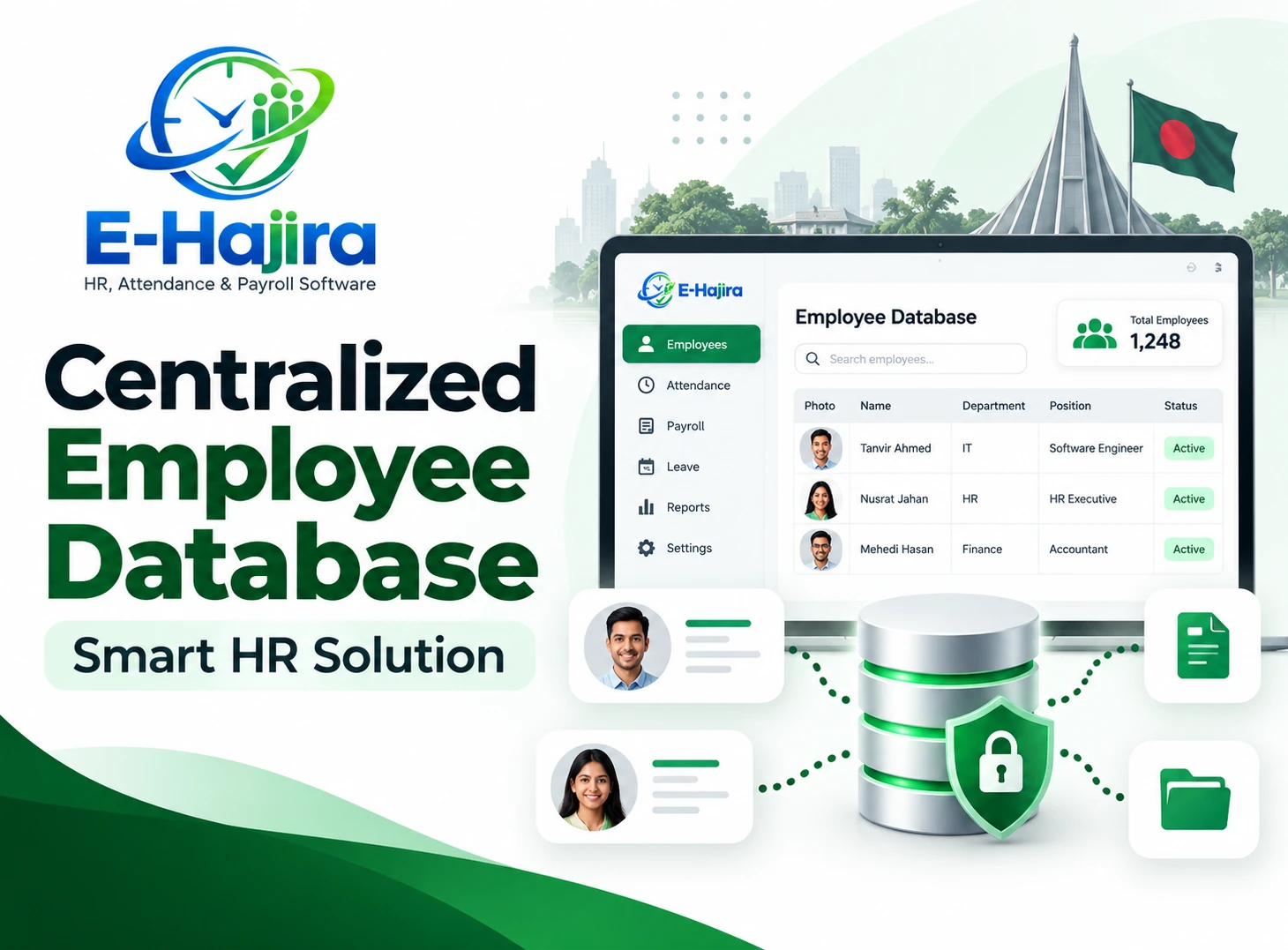
Centralized Employee Database Management in Bangladesh: eHajira HRMS – Smart HR Solution
Introduction: Transforming Employee Information Management in Bangladesh
Effective employee information management is essential for every successful organization. As businesses in Bangladesh expand their operations, managing employee profiles, employment documents, attendance records, salary information, departmental assignments, and employment histories becomes increasingly complex.
Many organizations still maintain employee information using paper files, spreadsheets, and disconnected HR applications. Although these methods may work for small teams, they often create administrative challenges as the workforce grows.
Missing documents, duplicate employee records, outdated information, inconsistent data, and delayed HR reporting can affect operational efficiency and management decisions.
Centralized Employee Database Management Software addresses these challenges by bringing essential employee information into one structured digital environment.
eHajira HRMS is designed to help organizations in Bangladesh manage core HR functions, including employee information, attendance, shift scheduling, leave administration, and payroll operations.
This article explores how centralized employee database management works, why businesses in Bangladesh increasingly need digital HR records, and how eHajira HRMS can support more efficient workforce administration.
What Is Centralized Employee Database Management?
Centralized Employee Database Management is a digital approach to collecting, organizing, updating, and maintaining employee information within a unified system.
Instead of maintaining separate employee records in different departments, branches, spreadsheets, or physical files, organizations use a central platform to manage authorized employee data.
A comprehensive employee database typically includes:
Personal and contact information
Unique employee identification numbers
Employment and joining details
Department, designation, and branch assignments
Employment type and status
Salary and compensation information
Attendance and leave records
Employment documents
Transfer and promotion history
Resignation and exit information
Centralization does not necessarily mean that every user can access every record. A properly designed HRMS uses role-based permissions to control who can view or modify specific information.
The primary objective is to create a reliable and accessible source of employee information for authorized HR and management personnel.
Why Bangladesh Needs Centralized Employee Database Software
Bangladesh has a diverse business environment comprising manufacturing industries, ready-made garments, healthcare providers, retail chains, educational institutions, financial services, and growing technology companies.
These industries have different operational requirements, but they share a common need for accurate employee information.
According to the Bangladesh Garment Manufacturers and Exporters Association (BGMEA), ready-made garment exports reached approximately USD 39.35 billion in fiscal year 2024–25. This illustrates the economic importance of an industry where organized workforce administration is particularly relevant.
However, employee database management is equally valuable for medium-sized businesses, hospitals, service providers, and organizations operating across multiple branches.
Common HR Data Management Challenges
1. Scattered employee information
Employee documents may be stored across separate computers, filing cabinets, email accounts, and spreadsheets.
2. Duplicate employee records
Without unique identifiers and standardized registration processes, the same employee may appear in multiple databases.
3. Difficult information retrieval
HR personnel may spend unnecessary time locating appointment letters, employee details, or historical records.
4. Inconsistent information
An employee's designation, department, salary structure, or contact information may differ between departmental records.
5. Limited branch-level visibility
Organizations with several offices or factories may struggle to consolidate employee information for management reporting.
6. Documentation and compliance risks
Incomplete or outdated employment documentation can complicate internal reviews and regulatory inspections.
Centralized HR software helps organizations establish consistent recordkeeping procedures and reduce these operational challenges.
Introducing eHajira HRMS: A Smart HR Management Solution
eHajira HRMS is a web-based human resource management platform focused on organizing employee information and supporting essential HR operations.
Its relevant management areas include employee registration, employee profiles, departmental organization, attendance management, shift scheduling, leave administration, and payroll processing.
By maintaining structured employee information, HR teams can establish a consistent foundation for related administrative activities.
For example, an employee's assigned department and shift can provide important context for attendance verification. Similarly, accurate employment and salary information supports payroll preparation.
eHajira is particularly relevant to organizations seeking to move from fragmented manual processes toward coordinated digital HR administration.
The availability of advanced workflows, specific security controls, integrations, and automation features should be verified for the organization's selected deployment and configuration.
Key Features of Centralized Employee Database Management
1. Centralized Employee Profile Management
Employee Profile Management provides a structured location for maintaining essential employment information.
HR administrators can organize employee identification, joining details, employment status, department, designation, and other authorized fields.
This approach reduces dependence on multiple disconnected records and improves administrative consistency.
2. Unique Employee Identification
A unique Employee ID helps organizations distinguish individual workers and connect their records across relevant HR processes.
This is especially important for organizations employing workers with similar names or operating multiple branches.
Consistent employee identifiers also improve data import, record searching, attendance matching, and reporting.
3. Digital Employee Document Management
Employee records may include appointment letters, identification documents, educational certificates, employment contracts, and supporting documentation.
Digital document management allows organizations to organize these materials in a structured electronic repository.
When evaluating eHajira, businesses should confirm the supported file formats, document upload functionality, storage limits, access permissions, and retention procedures.
4. Department and Designation Management
Companies typically divide their workforces into departments such as Human Resources, Finance, Production, Sales, Administration, and Operations.
A structured HR database maintains consistent departmental and designation information.
This supports reporting, employee assignment, and organizational planning.
5. Employee Joining and Employment Status
Employee records should contain essential joining information, including employment start date, employment category, assigned department, and current status.
Maintaining accurate employment status is important for identifying active, inactive, resigned, or otherwise separated employees.
6. Branch-Wise Employee Management
Organizations operating multiple branches require consistent employee information across different locations.
A centralized database can support branch-based workforce organization while allowing authorized central administrators to review information across the company.
Branch-level permissions should be configured according to operational requirements.
7. Employment History and Administrative Changes
Employees may change departments, receive promotions, or transfer between branches.
Recording such changes creates a more complete picture of their employment history.
Historical records also help HR departments investigate previous assignments and prepare internal administrative reports.
8. Integration with Attendance and Payroll
Employee information becomes more useful when connected with operational HR functions.
Attendance systems require valid Employee IDs and shift assignments, while payroll processing depends on accurate employment and compensation information.
eHajira's broader HR, Attendance, and Payroll framework provides a foundation for coordinating these activities.
How Centralized Employee Records Improve Daily HR Operations
A centralized employee database reduces the need to repeatedly collect the same information for different administrative purposes.
When HR teams maintain consistent employee profiles, related departments can work with authorized information without creating unnecessary duplicate records.
For example, an employee's joining date may be relevant to employment history, leave eligibility, and payroll administration.
Similarly, an employee's assigned branch influences workforce reporting and may affect attendance-device assignments.
Structured information management also makes it easier to identify incomplete records and establish standardized administrative procedures.
This can improve collaboration between HR, Accounts, Administration, and Operations departments.
Digital HR Records and Bangladesh Labour Law
Organizations in Bangladesh must consider applicable employment documentation and recordkeeping obligations.
The Bangladesh Labour Act, 2006, as amended, contains requirements relating to appointment letters, identity cards, service books, and worker registers.
For example, Section 5 addresses appointment letters and identification cards, while Sections 6–9 cover service books and worker-related records.
Section 9 specifies information that must be maintained in the worker register, including relevant personal details, employment information, workplace assignments, and working-time information.
Digital employee database software can help organize information relevant to these requirements.
However, businesses must confirm whether a particular digital record, document format, signature, or storage arrangement satisfies the applicable legal requirements.
A digital HRMS does not automatically replace every legally required document or register.
Organizations should also review applicable labour rules, recent amendments, and sector-specific requirements with qualified advisers.
Employee Data Privacy and Information Security
Employee databases contain sensitive business and personal information.
Records may include national identification details, addresses, salary information, banking information, and employment documents.
Protecting this information is essential.
Bangladesh enacted the Personal Data Protection Act, 2026, which establishes a legal framework for handling personal data. Its provisions include phased implementation requirements.
Organizations should assess their responsibilities under applicable data protection rules and maintain appropriate safeguards.
Important controls to evaluate in an HRMS include:
Role-based access permissions
Secure authentication
Restricted document visibility
Audit trails for important changes
Encrypted data transmission
Appropriate backup and recovery procedures
Defined data retention policies
Authorized employee information access
Secure handling of inactive employee records
These are recommended security requirements for procurement and implementation. Businesses should verify which specific controls are available in their eHajira deployment.
Industry Applications in the Bangladesh Market
Ready-Made Garments and Textile Manufacturing
Garment factories maintain employee records across production, quality control, maintenance, administration, and other departments.
Centralized employee information supports staff identification, workforce administration, departmental organization, and HR reporting.
It can also provide a useful foundation for attendance and shift management.
Manufacturing and Industrial Operations
Manufacturing businesses frequently operate multiple departments, production facilities, and shift schedules.
Maintaining accurate employee assignments is important for coordinating attendance, manpower distribution, and payroll information.
Hospitals and Healthcare Organizations
Hospitals employ doctors, nurses, technicians, administrative employees, and support personnel.
Centralized employee records help organize professional information, departmental assignments, and relevant employment documentation.
Additional credential verification and professional compliance workflows may require specialized functionality.
Retail Chains and Supermarkets
Retail businesses operating outlets in Dhaka, Chattogram, Sylhet, and other locations benefit from consistent employee identification and branch-specific records.
A centralized database can support employee movement between outlets and improve head-office workforce visibility.
Corporate Offices and IT Companies
Corporate organizations often prioritize efficient onboarding, leave management, employment records, and salary administration.
Digital HR records help reduce paper-based administration and support structured employee information management.
Security and Facility Management Companies
Security providers may deploy personnel across different client locations.
Consistent employee identification, job assignments, branch information, and employment status records are important for managing a distributed workforce.
Traditional Employee Records vs. Centralized HR Database
| Management Area | Traditional Process | Centralized HRMS Approach |
|---|---|---|
| Employee Profiles | Paper and spreadsheets | Structured digital records |
| Information Search | Manual file retrieval | Searchable employee information |
| Employee IDs | Potential inconsistencies | Standardized identification |
| Department Records | Separate files | Central organization |
| Branch Reporting | Manual consolidation | Branch-based data structure |
| Employment History | Scattered documentation | Organized historical records |
| Attendance Coordination | Separate matching | Integrated data framework |
| Payroll Preparation | Repeated data entry | Shared employee information |
| Access Management | Physical/file permissions | Configurable user permissions |
| Scalability | Increasing manual workload | Structured expansion |
The actual benefits depend on data quality, user training, configuration, and the software capabilities implemented.
Business Benefits of eHajira-Based Employee Database Management
Improved Administrative Efficiency
A central database helps authorized users locate employment information without searching multiple disconnected sources.
Better Data Consistency
Standardized employee profiles reduce the likelihood of inconsistent department names, employee identifiers, and employment details.
Faster HR Reporting
Structured data makes it easier to prepare headcount, department, branch, and employment-status reports.
Reduced Paper Dependency
Digitizing eligible records can reduce physical storage requirements and repetitive paperwork.
Better Attendance Coordination
Accurate employee identification and shift information support more reliable attendance processing.
Improved Payroll Administration
Consistent employee and salary information provides a stronger foundation for payroll verification.
More Organized Workforce Planning
Management teams can evaluate workforce distribution across branches and departments using relevant reports.
Support for Business Growth
As an organization expands, centralized employee administration provides a more scalable alternative to disconnected spreadsheets.
These are potential operational benefits rather than guaranteed financial or productivity outcomes.
Practical Example: Multi-Branch HR Management
Consider a hypothetical Bangladeshi service company operating five branches with a total workforce of 500 employees.
Each branch maintains 100 employee records.
With separate spreadsheets, the head office may need to collect and consolidate five different files whenever employee information changes.
A centralized HRMS approach allows branch-level employee records to follow a consistent structure while authorized head-office administrators review consolidated information.
When an employee transfers between branches, the organization can update the relevant assignment and maintain an appropriate employment history.
This example illustrates an operational use case, not a verified eHajira customer implementation.
How to Implement Centralized Employee Database Management
Successful implementation requires more than installing software.
Step 1: Review existing HR records. Identify where employee information is stored and which records require correction.
Step 2: Standardize employee information. Establish consistent Employee IDs, department names, designation structures, and employment categories.
Step 3: Prepare digital records. Organize employee documents and ensure authorized data collection.
Step 4: Configure organizational structures. Define branches, departments, designations, and relevant administrative roles.
Step 5: Establish access permissions. Determine which users can view, create, update, approve, or export information.
Step 6: Import and validate employee data. Check for duplicates, incomplete profiles, and inaccurate assignments.
Step 7: Verify related HR workflows. Test attendance, leave, roster, and payroll coordination where applicable.
Step 8: Train employees and administrators. Provide practical guidance on record creation, modification, and information security.
Step 9: Launch a pilot implementation. Begin with a selected branch or department before wider deployment.
Step 10: Conduct regular data reviews. Periodically verify accuracy, permissions, backups, and administrative procedures.
A phased implementation helps organizations identify problems early and establish sustainable digital HR practices.
How to Choose Employee Database Management Software in Bangladesh
Organizations should evaluate HR software based on practical business requirements rather than promotional claims alone.
Important selection criteria include employee profile management, document handling, department and branch structures, user permissions, information security, reporting, system integration, implementation support, and ongoing costs.
Businesses should also examine how easily employee data can be imported and exported, how historical records are maintained, and whether the software can accommodate future organizational growth.
For organizations considering eHajira HRMS, a product demonstration should validate required features using realistic employee-management scenarios.
Why Consider eHajira HRMS?
eHajira brings employee information management into a broader HR administration environment.
Its combination of employee profiles, attendance management, shift scheduling, leave administration, and payroll-related processes makes it relevant for organizations seeking coordinated workforce operations.
For Bangladeshi businesses transitioning from manual recordkeeping, its HRMS framework offers a structured approach to organizing essential employee information.
Organizations requiring advanced document workflows, automated expiry reminders, specialized integrations, or detailed security features should verify those capabilities before procurement.
Conclusion
Centralized Employee Database Management is a fundamental part of modern Human Resource Management.
As Bangladeshi organizations expand their workforces and operations, disconnected employee records can create unnecessary administrative complexity.
A structured digital HR database improves record organization, supports information consistency, and provides a stronger foundation for attendance, leave, shift scheduling, and payroll administration.
eHajira HRMS offers a practical approach to bringing these core HR activities into a coordinated management environment.
Organizations looking to modernize employee information management should evaluate their existing HR processes, define essential requirements, and select a solution that supports both operational efficiency and responsible data management.
Ready to simplify employee records and modernize HR operations? Explore eHajira HRMS and request a product demonstration tailored to your organization's workforce management requirements.
Frequently Asked Questions (FAQ)
1. What is centralized employee database management?
Centralized employee database management is the process of organizing employee information in a unified digital system that authorized personnel can access and maintain.
2. What is employee database management software?
Employee database management software is an application used to organize employee profiles, employment details, departmental assignments, and related HR information.
3. Why is centralized employee information important in Bangladesh?
It helps businesses manage employment records consistently, coordinate multiple departments, and support applicable administrative and legal recordkeeping requirements.
4. What is eHajira HRMS?
eHajira HRMS is a web-based human resource management platform covering employee information, attendance, leave, shift scheduling, and payroll-related administration.
5. Can eHajira manage employee profiles?
Employee Profile Management is part of eHajira's HR management scope. Organizations should verify the available fields and configuration options during demonstration.
6. Is eHajira suitable for small businesses?
It may be suitable for small businesses seeking structured employee records, although pricing, modules, and implementation requirements should be evaluated.
7. Can centralized HR software manage multiple branches?
Yes. Multi-branch HR software can organize employee records by location while providing appropriate central oversight.
8. What employee information should an HR database contain?
Common records include Employee ID, joining date, department, designation, employment status, contact information, and relevant authorized documentation.
9. Can employee records be stored digitally?
Yes, many employee records can be stored digitally. Organizations must also determine whether original documents or prescribed formats are legally required.
10. Does eHajira support biometric attendance?
Biometric attendance integration is part of eHajira's functional scope. Compatibility with individual devices should be confirmed.
11. How does employee database software support payroll?
It provides consistent employee identification, employment information, and relevant salary-related data for payroll preparation and verification.
12. Can eHajira track employee transfers?
Transfer and employment-history management are relevant to its HR framework. The specific workflow and historical tracking capability should be verified.
13. What is digital HR record management?
Digital HR record management involves creating, storing, updating, retrieving, and protecting employment-related information electronically.
14. Is centralized employee database software secure?
Security depends on the implemented controls, including authentication, permissions, encryption, backups, and operational policies.
15. Can employee information be exported from HR software?
Many HR platforms offer data export functionality. Businesses should confirm eHajira's supported formats and export permissions.
16. Does HRMS software replace paper employee registers?
Not automatically. Organizations must verify whether digital alternatives satisfy applicable labour law and documentation requirements.
17. Can eHajira help manage employee resignation records?
Employee exit information is part of its management scope. Automated clearance and final-settlement workflows should be confirmed separately.
18. What industries benefit from centralized employee databases?
Manufacturing, garments, healthcare, retail, hospitality, education, security services, and corporate organizations can benefit.
19. How can employee data duplication be reduced?
By assigning unique identifiers, validating imported records, and establishing standardized employee registration procedures.
20. Does centralized HR software improve workforce reporting?
Yes. Structured employee data can support headcount, departmental, branch-level, and employment-status reporting.
21. What is the difference between HRMS and employee database software?
Employee database software focuses on employee records, while HRMS typically covers broader functions such as attendance, leave, payroll, and workforce administration.
22. How long does HRMS implementation take?
Implementation time depends on workforce size, data quality, required modules, integrations, and organizational complexity.
23. Can eHajira integrate employee records with attendance and payroll?
Its broader HRMS framework includes these areas. The exact integration and automation behavior should be confirmed for the selected configuration.
24. What should businesses check before purchasing HRMS software?
They should review functionality, data protection, integration compatibility, reporting, employee capacity, vendor support, pricing, and implementation requirements.
25. Why choose eHajira for employee database management in Bangladesh?
eHajira is a relevant option for businesses seeking to coordinate employee records with attendance, shifts, leave, and payroll administration through a structured HRMS environment.
Take the Next Step with eHajira HRMS
Centralize Employee Records. Simplify HR Operations. Build a Smarter Workforce.
Move beyond disconnected spreadsheets and paper-based employee files. Discover how eHajira HRMS can support structured employee information management and more efficient HR administration in Bangladesh.
Request an eHajira HRMS Demo Today.
Recent Post