 EAS Security
 EAS Gate
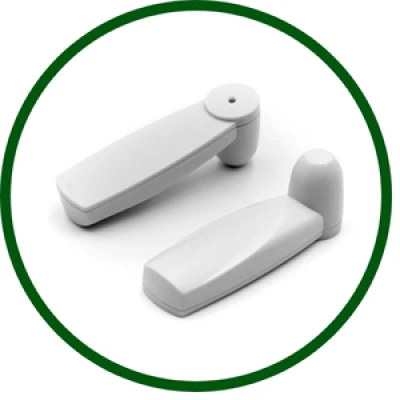 Security Tag
 EAS Accessories
 Gadgets
 Convex Mirror
 Road Barrier
 Burglar Alarm
 Calling System
Managing Employee Transfers Across Multiple Branches with eHajira
October 26, 2026

Managing Employee Transfers Across Multiple Branches with eHajira
An employee transfer affects more than the location shown in an HR record. It can change attendance arrangements, supervision, working hours and the information used during payroll preparation. For businesses operating across Bangladesh, coordinating these changes is essential to keeping employees productive and administrative records reliable.
Consider an employee moving from a Dhaka head office to a Chattogram branch. The receiving manager needs to know when the person will arrive. HR needs an accurate assignment record. Attendance administrators must prepare the appropriate registration, while finance needs clarity about any approved compensation changes.
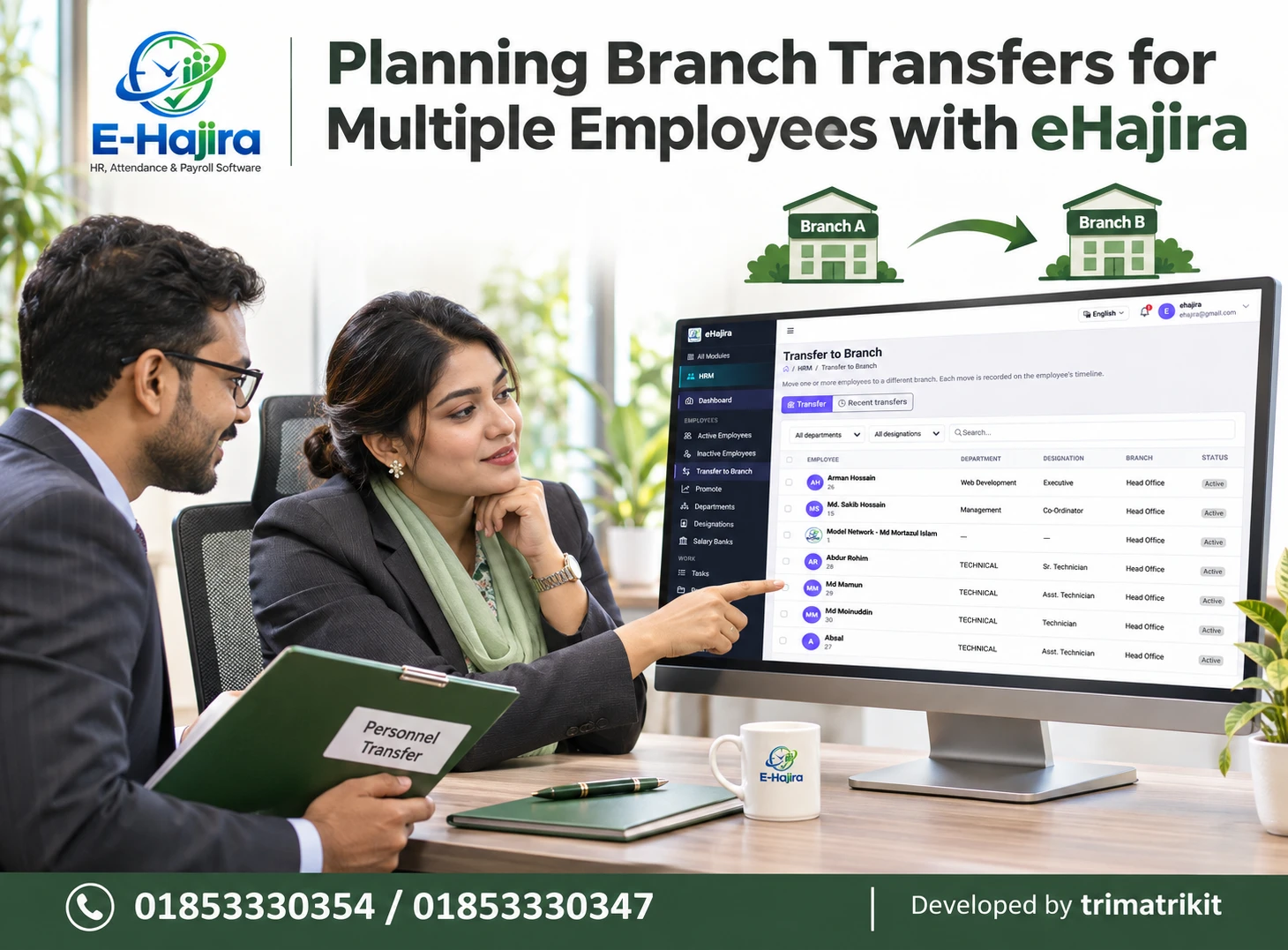
eHajira provides a practical foundation for managing this movement. Its published Transfer to Branch feature updates an employee’s current assignment while retaining previous history. This allows HR to manage an internal move without treating the person as a completely new employee.
This guide explains how businesses can organize branch transfers around eHajira’s documented capabilities. The operational examples are recommended practices rather than claims that every supporting action happens automatically.
What Employee Transfer Management Involves
Employee transfer management coordinates an employee’s movement between organizational locations or assignments. A complete process establishes where the employee is moving, when the change takes effect and which responsibilities must be handed over.
The administrative record is one part of that process. The employee also needs clear reporting instructions, and the receiving branch needs time to prepare.
A branch transfer does not necessarily mean a promotion, salary increase or department change. These decisions may happen together, but each needs separate confirmation. Keeping them distinct prevents an approved location change from being interpreted as authorization to alter unrelated employment arrangements.
Why Branch Transfers Matter in Bangladesh
For a business operating in Dhaka, Gazipur, Chattogram and Sylhet, employee movement can support a new outlet, fill a vacancy or bring experienced staff into a developing team. These are practical operating scenarios rather than claims about measured transfer volumes.
The challenge is maintaining continuity across locations. One branch may use different attendance equipment, follow another shift pattern or rely on a different supervisor for approvals.
Bangladesh-focused software listings reflect these varied requirements. eHajira’s retail offering includes multi-branch consolidation, while its corporate office and IT/services offering also describes organizational structure and access-control functions. These published configurations demonstrate the importance of matching software scope to the employer’s operating model.
A Central Employee Record for Internal Movement
An internal transfer should preserve the employee’s identity within the organization. Creating an unnecessary second record can fragment information and make it harder to distinguish a transfer from a new appointment.
With eHajira’s documented transfer function, the central concept is continuity: the employee remains the same person while their current branch assignment changes.
HR should establish a consistent identification practice before processing transfers. The employee’s approved identity should connect the relevant records, and administrators should investigate possible duplicates before adding another profile.
This is especially useful when employees return to a former branch. The objective is a coherent employment record, supported by clear documentation of movement, rather than several disconnected profiles representing different locations.
Distinguishing Branch, Department and Designation
Branch, department and designation describe different aspects of employment. The branch identifies the organizational location. The department describes the functional team, while the designation identifies the position.
eHajira’s published HR description includes department management and a separate promotion function that updates a position and records promotion history. This supports treating organizational changes as related but distinct actions.
For example, a sales executive may move between branches without changing department or designation. Another employee may transfer and become a branch supervisor simultaneously.
Before updating the system, HR should identify exactly what management approved. Clear distinctions improve reporting and reduce confusion about responsibilities, authority and compensation.
Preparing Branches for Consistent Administration
Reliable transfer management begins with consistent organizational setup. Branch names should be recognizable, and administrators should understand which location each record represents.
A practical naming convention might distinguish the city, site and operational purpose. “Dhaka Warehouse” provides more context than an unexplained abbreviation, particularly when head office manages several locations.
Businesses should also agree on who maintains branch information and who confirms that the receiving location is ready. Unused or duplicate location records can make routine transfers unnecessarily difficult.
Before launching a new process, HR should review the existing structure with operational managers. Correcting inconsistent naming and ownership early is easier than resolving misclassified employees after reports have already been circulated.
Starting with an Approved Transfer Decision
The process should begin with an approved instruction that identifies the employee, destination and intended timing. HR also needs to know whether the move is permanent or temporary and whether any related employment terms change.
These details can be documented through the organization’s established approval process. The reviewed sources do not establish that every eHajira package includes a dedicated transfer-request approval engine.
That distinction matters. Permission to edit an employee record is different from business authorization to move the employee.
A clear approval record gives the system operator an accurate instruction to implement. It also helps the employee and both branch managers understand what has been decided.
Updating the Assignment in eHajira
After approval, an authorized HR user can use the documented branch-transfer capability to update the employee’s assignment.
The operator should first confirm that the selected profile belongs to the intended employee and that the destination branch is correct. After saving, HR should review the resulting assignment rather than assuming the change was applied as intended.
The exact interface and available fields should be demonstrated in the organization’s deployed version. Future-dated scheduling, bulk transfer processing and automatic downstream updates should not be assumed without confirmation.
For routine administration, a short verification step is valuable. It catches selection mistakes before the updated record becomes the basis for attendance review, reporting or other operational decisions.
Coordinating Release and Arrival Dates
A transfer can involve several dates: the approval date, the final working day at the original branch and the first reporting day at the destination. These dates may differ.
HR should communicate the operational timeline clearly. If an employee finishes at one location on Thursday and reports elsewhere on Sunday, the intervening period needs an agreed administrative treatment.
Travel arrangements, delayed arrival or a revised release date should be handled through the employer’s approved process. The system record should reflect the confirmed arrangement.
Where future-effective transfers are required, businesses should verify how their eHajira deployment handles them. A current assignment field alone should not be interpreted as evidence of scheduled transfer automation.
Keeping Attendance Working at the New Branch
Attendance continuity is one of the most important practical concerns during a transfer. An employee may arrive on time but still encounter missing records if registration at the new location is incomplete.
eHajira’s published manufacturing specifications include attendance synchronization with compatible biometric and RFID devices. Its attendance workflow also describes devices, shifts, assignments, punches, logs and corrections as connected working areas.
The receiving branch should test the approved attendance method and confirm that the entry appears against the correct person.
A branch change should not be assumed to distribute biometric templates automatically between all devices. Equipment compatibility, enrollment arrangements and connectivity need their own verification.
Reviewing Shifts and Local Working Arrangements
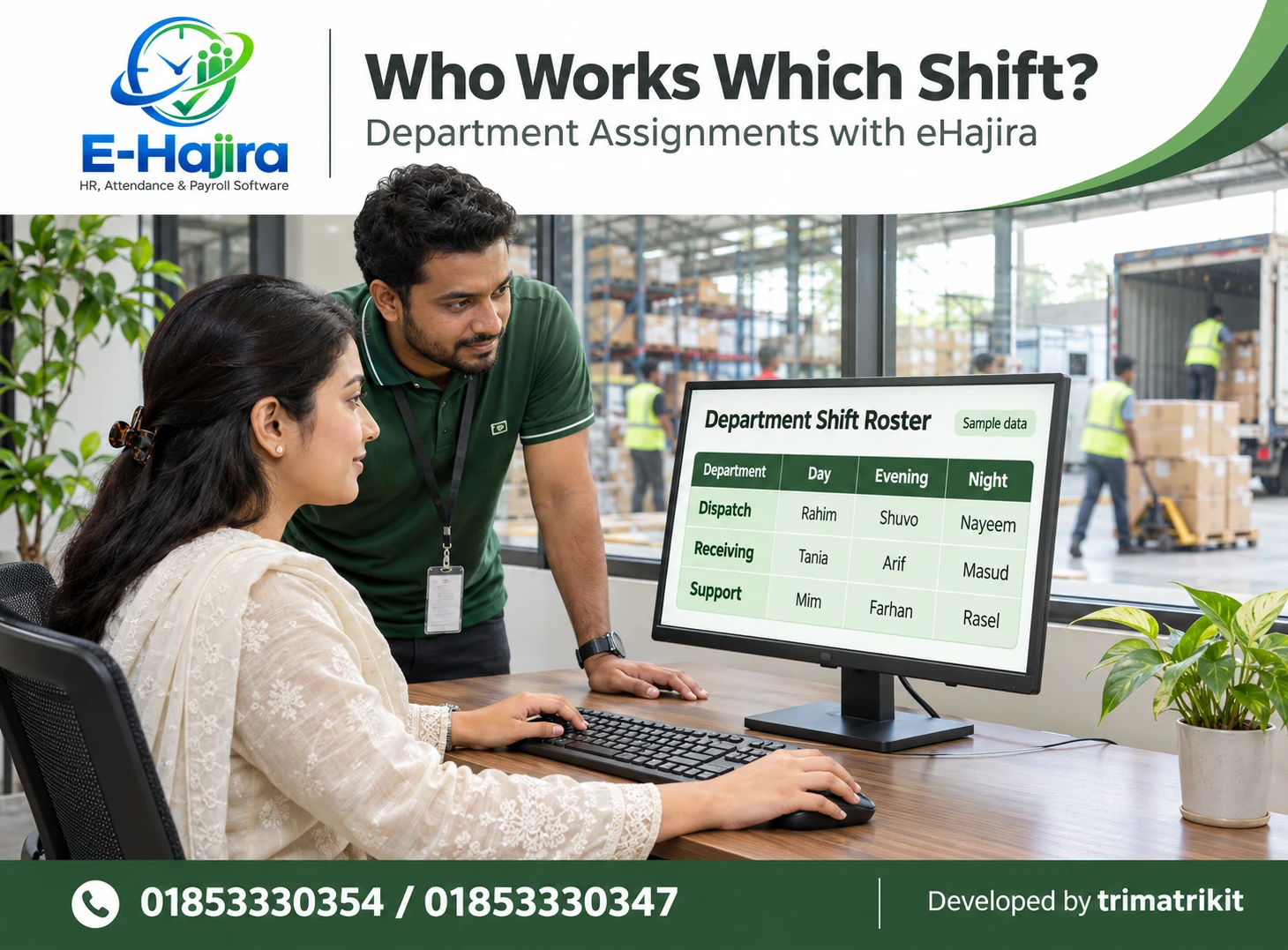
A transfer may place an employee into a different schedule. The new branch might operate evening hours, rotating duties or a different weekly roster.
eHajira’s corporate and manufacturing offerings describe shift and roster management. These functions can support the administrative arrangement, but the employee still needs a clear explanation of their actual schedule.
HR should coordinate the final assignment at the previous branch with the first assignment at the destination. Overlapping or missing schedules can complicate attendance interpretation.
The receiving manager should also explain how future changes will be communicated. A correct system entry is useful only when employees understand the working arrangement it represents.
Maintaining Leave and Approval Continuity
An employee may have pending leave requests or previously approved absence when a transfer occurs. These should be reviewed before responsibility passes to the receiving team.
Relevant eHajira packages include leave applications and approval workflows. However, the reviewed specifications do not establish that a branch transfer automatically redirects every pending request to a new manager.
A practical handover should identify unresolved requests and clarify who will decide them. Previously approved leave should be communicated so that the receiving branch can plan staffing appropriately.
Employees should also know their new point of contact. Clear communication prevents requests from remaining unattended because each manager assumes the other is responsible.
Protecting Payroll Accuracy During Transfers
A branch move may leave compensation unchanged, or it may accompany approved adjustments. Finance needs to distinguish these situations before processing salary.
eHajira’s Enterprise Standard offering lists automated payroll processing and payslip generation. These capabilities support salary administration, but payroll accuracy still depends on verified inputs and appropriate configuration.
For a mid-month transfer, payroll staff should review attendance continuity and any compensation changes separately. They should also establish how costs will be allocated internally if different branches bear different portions.
Automatic salary proration or branch-level cost splitting should not be assumed from a transfer function alone. Demonstrating the required calculation with a representative example provides a stronger basis for implementation.
Reviewing Access After a Transfer
Transfers can change what information an employee needs to view or manage. Someone moving into supervision may need additional access, while access connected to previous duties may no longer be appropriate.
eHajira’s corporate office and IT/services Business Ultimate listing explicitly includes role-based access control. This provides a documented foundation for configuring access according to responsibilities.
The administrator should review permissions alongside the operational move. Changing a designation should not be treated as confirmation that every access setting has changed automatically.
The intended result is practical: employees can perform their new responsibilities, and information remains available only to people who require it for their work.
Completing the Operational Handover
The original branch should explain outstanding work before the employee leaves. Depending on the role, this may involve customer matters, equipment, stock responsibilities or unfinished administrative tasks.
These activities need named owners and an agreed completion point. The transfer record should not be treated as evidence that operational handover is finished.
A useful comparison comes from BRAC International’s public HRMS training catalogue, which separately identifies transfer proposals, authorization, charge handover and joining after transfer. This is an example of process separation, not evidence that the organization uses eHajira.
Businesses can apply the underlying principle: moving the employee record and transferring responsibility are connected actions that need independent confirmation.
Reviewing Reports Without Losing Historical Meaning
After a transfer, HR needs to confirm that the employee appears in the expected current branch view. Historical reporting requires a separate check.
eHajira’s published transfer description says previous history is retained. That does not establish how every report attributes past attendance or payroll costs after the current assignment changes.
A useful acceptance test is to compare a report from before the transfer with one covering the transfer period. HR should examine whether the output answers the intended question.
A current staffing report and a historical cost report serve different purposes. Businesses should define their reporting expectations and verify the relevant output before relying on it for management decisions.
A Bangladesh-Based Transfer Example
Consider a hypothetical retail company moving an experienced employee from Dhaka to a new Cumilla outlet. The employee keeps the same designation but begins a different shift.
Head office approves the move and communicates the release and arrival arrangements. HR updates the branch assignment in eHajira, while the receiving manager prepares the schedule and confirms attendance registration.
Finance checks that no salary change was approved and reviews the transfer month for missing attendance. The employee receives instructions about supervision, leave requests and local procedures.
After the first week, HR verifies the assignment and resolves remaining issues. This illustrates how eHajira can support a coordinated process; it is not a documented customer case study.
Measuring Transfer Management Improvements
Businesses should evaluate transfer quality through practical outcomes. Useful measures include the time between approval and completed registration, the number of attendance problems after arrival and payroll corrections connected with transfers.
Employee feedback is equally useful. A technically accurate move can still feel disorganized if the person receives unclear reporting instructions or cannot identify the new supervisor.
These measures can be reviewed using available records and a separate management log where necessary. They should not be assumed to exist as dedicated transfer analytics in every package.
A small pilot involving representative branches helps reveal process gaps before the organization introduces the same approach more widely.
Frequently Asked Questions
1. What is employee branch transfer management?
It is the coordinated process of moving an employee between locations while keeping employment records and operational arrangements consistent. It includes approval, assignment updates, attendance preparation, communication and handover. The objective is continuity for both the employee and the business.
2. Does eHajira have a branch-transfer feature?
Yes. Its published HR documentation identifies a Transfer to Branch function. It describes changing the employee’s current assignment while preserving previous history. Organizations should confirm the relevant package and demonstrate the workflow in their deployed version.
3. Should HR create a new profile after a transfer?
Normally, an internal move should continue under the employee’s existing identity. Creating another profile can split information and complicate reconciliation. HR should use the approved transfer process and investigate duplicate records rather than treating every location change as fresh recruitment.
4. Is a branch transfer the same as a promotion?
No. A transfer changes location or assignment, while a promotion changes position or responsibility. They may occur together, but each requires clear approval. HR should avoid assuming that a branch move also authorizes changes to designation or compensation.
5. Can eHajira record promotions separately?
The published module description includes a separate promotion function and promotion history. This supports distinguishing career progression from branch movement. HR should confirm which approved changes apply to the employee and process them through the relevant functions.
6. What information should HR confirm before a transfer?
HR should confirm the employee’s identity, destination, release arrangement and expected arrival. Any approved changes to department, supervision, schedule or compensation should be explicit. Clear instructions reduce the risk of administrators making assumptions during the update.
7. Can an organization schedule a future transfer automatically?
The reviewed sources do not establish universal future-dated transfer automation. Businesses needing that capability should demonstrate it in their deployment. Until confirmed, HR should manage the timing through an approved process and verify the assignment when the change becomes effective.
8. Will biometric registration move automatically?
Not necessarily. A branch assignment update does not prove that biometric templates have reached another device. The receiving branch should verify compatibility, registration and synchronization, then confirm a successful attendance entry under the employee’s correct identity.
9. Why should attendance be checked after arrival?
A first-day check can identify missing enrollment, incorrect identity mapping or connectivity problems. Resolving these issues early prevents several days of uncertain records. Employees should also know how to report a missing entry without creating additional confusion.
10. Does the employee’s shift need to change?
Only when the approved working arrangement changes. HR should compare the old and new schedules and coordinate the transition. Even if the hours remain identical, the receiving manager should confirm the employee’s reporting instructions and applicable roster.
11. What happens to pending leave requests?
HR should review pending requests and clarify which manager remains responsible. The existence of leave approval functionality does not establish automatic reassignment after a transfer. Approved absence should also be communicated to help the receiving branch plan staffing.
12. Does transferring branches automatically change salary?
A branch transfer should not be treated as automatic authorization for a salary change. Finance should follow approved compensation instructions. Where an adjustment accompanies the move, its amount, timing and calculation method need separate verification.
13. Can eHajira split salary costs between branches?
The reviewed sources do not confirm universal automatic cost splitting for transfer periods. Employers requiring this should demonstrate the expected output with their implementation team. A current branch assignment and historical cost allocation are different reporting requirements.
14. Can existing employment history be retained?
The published transfer description states that previous history is maintained. HR should still test the historical views and reports important to the organization. Retaining information does not necessarily mean every report classifies past activity in the same way.
15. Who should be allowed to update transfers?
The organization should assign that responsibility to authorized users. Business approval and system editing rights should be defined separately. A person who can change records should act on approved instructions rather than independently deciding where employees will work.
16. Should permissions be reviewed after a transfer?
Yes. A new role or location may change access requirements. Administrators should confirm what the employee needs for current duties and review access associated with previous responsibilities. This review should accompany the move rather than depend on assumptions.
17. Can temporary assignments use the same process?
Temporary assignments need an explicit administrative approach. A short visit may not require changing the permanent branch record. HR should establish how attendance, supervision and reporting will work, then confirm whether the available configuration supports that arrangement.
18. Is branch transfer the same as transfer between companies?
No. Moving within one employer differs from moving between separate employing entities. Multi-company functionality does not remove that distinction. HR and finance should define the required treatment before changing records across company boundaries.
19. How can businesses assess whether transfers are improving?
Track completion time, attendance exceptions, unresolved handovers and payroll corrections. Ask employees whether they received clear instructions and support. Reviewing several transfers provides a more useful picture than judging success solely by how quickly a record was edited.
20. How should a business begin using eHajira for transfers?
Start with a representative case involving two branches. Demonstrate the assignment change, verify attendance and review the relevant reports. Define responsibilities, document any configuration gaps and pilot the process before extending it across the organization.
Build a Consistent Transfer Process with eHajira
A well-managed transfer preserves continuity while preparing the employee for a new location. The strongest process connects accurate records with practical attendance arrangements, payroll review and clear communication.
eHajira’s documented branch-transfer capability provides a useful starting point for businesses in Bangladesh. Combined with the appropriate HR, attendance and payroll functions, it can support a more organized approach to internal employee movement.
Begin with a realistic transfer scenario and confirm the workflow your branches need. A consistent process gives HR dependable information, helps managers prepare and allows employees to settle into their new assignments with fewer administrative obstacles.
Recent Post