EAS Security
 EAS Gate
 Security Tag
 EAS Accessories
 Gadgets
 Convex Mirror
 Road Barrier
 Burglar Alarm
 Calling System
How eHajira Helps HR Teams Organize Monthly Salary Processing
October 28, 2026
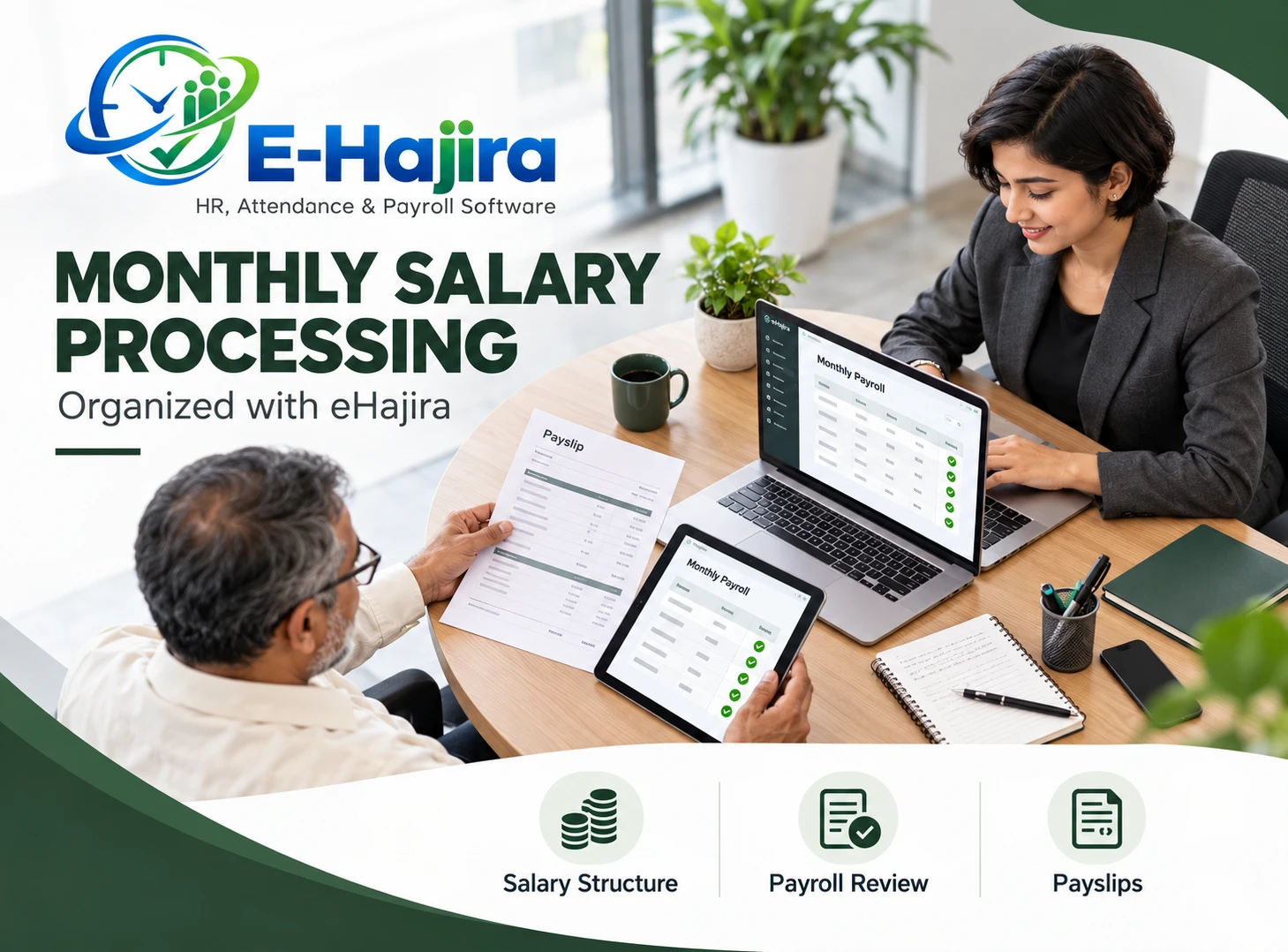
How eHajira Helps HR Teams Organize Monthly Salary Processing
Monthly salary processing brings together some of an organization’s most sensitive information. Employee details, salary structures, attendance, leave and approved adjustments must be reviewed before the final payroll is prepared. An error in one area can affect an employee’s payslip and create additional work for HR and finance.
For businesses in Bangladesh, payroll becomes more complicated as teams expand across departments, shifts and branches. A spreadsheet that once served a small office may become difficult to maintain when employee circumstances and payment components vary.
eHajira offers an HR, attendance and payroll environment designed to organize these connected activities. Its published product information describes salary structures, allowances, deductions, bonuses, payroll cycles and payslip generation using verified attendance and leave information.
This guide explains how HR teams can build a practical monthly salary workflow around eHajira, what should be verified before processing and how to keep payroll understandable for employees and management.
What Monthly Salary Processing Involves
Monthly salary processing is the administrative work required to determine an employee’s pay for a defined period. It combines the approved salary arrangement with any relevant information affecting that period.
The process may involve recurring earnings, approved additional payments and authorized deductions. It also requires consideration of employee changes, such as joining during the month or moving to a revised salary arrangement.
For example, a person joining midway through a period should not automatically receive the same calculation as someone employed throughout it. The correct treatment depends on the organization’s approved method and applicable requirements.
A reliable payroll process therefore involves preparation, calculation, review and approval. Software supports these stages, but the employer remains responsible for the rules and information used.
Why Payroll Organization Matters in Bangladesh
Businesses in Bangladesh include offices, factories, retailers, educational institutions and service companies. Their payment arrangements and employee schedules can differ considerably.
An organization may employ office staff with fixed salaries alongside operational employees working changing shifts. It may also manage several branches with local managers submitting attendance or adjustment information.
When payroll inputs arrive through unrelated files and messages, HR can struggle to identify which information is complete and authorized. A late attendance correction or an unclear allowance request can delay review.
A structured process gives departments a shared understanding of responsibilities. Employees know how to raise discrepancies, managers understand approval expectations, and finance receives information that has been checked rather than assembled at the last moment.
eHajira’s Role in the Payroll Workflow
eHajira connects payroll administration with employee and attendance information. This allows organizations to evaluate payroll as part of a broader HR process rather than a separate monthly spreadsheet exercise.
The provider describes both monthly and single payroll runs, together with payroll items and salary structures. Businesses should confirm how these functions operate in their selected package.
For example, an organization can demonstrate how an employee’s approved salary arrangement, attendance and a one-time payment are reflected in a sample calculation.
Implementation should establish the complete workflow, including who prepares inputs and who reviews the result. Advanced approvals, automatic bank payments, tax filing and payroll locking should be confirmed separately rather than assumed.
Beginning with Accurate Employee Records
Payroll needs to identify the correct employee before any calculation begins. Employee identifiers, employment dates and organizational assignments should therefore be maintained consistently.
Similar names can create confusion when HR relies only on manually prepared lists. Transfers and changes in employment status also need timely updates.
For example, an employee moving from one branch to another should not accidentally receive duplicate payroll records. A person who has left the organization should be handled according to the approved exit and payment process.
During an eHajira demonstration, test these situations using sample records. Confirm which employee fields influence payroll and how changes become effective for a particular period.
Building Clear Salary Structures
A salary structure defines the approved components of an employee’s remuneration. It should reflect the actual employment arrangement rather than a generic template applied without review.
Two employees may have the same overall salary but different component arrangements. Those distinctions can matter when the organization prepares statements or applies approved calculations.
eHajira’s published information describes configurable employee salary structures. The implementation team should demonstrate the organization’s own structure and explain how it is assigned.
For example, test whether a revised arrangement takes effect from the correct date. Confirm how historical information remains understandable when current salary details change.
Organizing Payroll Items
Payroll items provide a consistent way to identify earnings and deductions. Clear naming helps HR understand what each component represents and reduces the risk of similar items being used inconsistently.
For example, “transport allowance” and an approved transport expense reimbursement may have different purposes. Combining them without explanation can make a payslip difficult to interpret.
The provider describes payroll items as part of eHajira’s setup. The organization should use this capability according to its approved arrangements and verify the available configuration.
Before processing real salaries, test item names, calculation methods and presentation. Employees and reviewers should be able to understand the resulting output without relying on undocumented explanations.
Managing Recurring and One-Time Allowances
Some payments repeat each month, while others apply only to a particular period. The payroll process should distinguish these cases clearly.
A recurring allowance should not require an unnecessary new instruction every month if it forms part of the approved salary arrangement. A one-time payment should not continue indefinitely because it was entered in the wrong place.
For example, an employee may receive an approved temporary assignment allowance for one month. HR needs to confirm that it applies to the intended period and is not duplicated.
In eHajira, demonstrate both situations. Verify effective dates, input responsibilities and how the item appears in the payroll result before expanding the setup across the workforce.
Handling Deductions Responsibly
Deductions require a clear basis and appropriate authorization. The availability of a deduction field does not establish that any proposed deduction is permissible.
HR should identify the purpose, amount and applicable period before including an item. Relevant policies and legal requirements must be considered by responsible staff.
For example, an agreed repayment arrangement should be distinguished from a correction to an earlier payroll calculation. Both may affect net pay, but their administrative explanations differ.
eHajira can support configured deduction items, but employers should test the calculation and presentation. Employees should have an appropriate way to ask questions about a deduction rather than discovering an unexplained difference in their payslip.
Connecting Attendance to Payroll Preparation
Attendance can provide important payroll inputs, but raw punches should not be treated as final payment instructions. The records first need correct employee mapping, schedules and exception review.
An employee may have a missing check-out despite completing the working day. Another may appear late because an approved shift change was not entered.
Before salary processing, HR should resolve relevant discrepancies through the organization’s authorized procedure. The provider describes eHajira payroll as using verified attendance and leave information, making this preparation particularly important.
The organization should demonstrate how a corrected attendance record affects a sample payroll and whether additional processing is required before the updated result appears.
Reviewing Leave Information
Approved leave and unexplained absence are different situations. Payroll preparation should consider the correct leave classification and the organization’s applicable treatment.
Pending leave requests can create uncertainty at month-end. HR should establish a routine for identifying requests that require a decision before payroll review.
For example, an employee’s absence may already have an approved explanation, but the relevant information has not reached the payroll preparer. A connected workflow can reduce this gap when properly configured.
In eHajira, test a sample period containing the organization’s relevant leave scenarios. Confirm how the approved information is reflected and how later changes are handled without assuming that every leave category behaves identically.
Checking Overtime and Additional Work
A late check-out does not automatically establish approved overtime. The organization may need to review the assignment, authorization and applicable calculation method.
For example, extra time could represent authorized work, a missed punch or another circumstance. Those cases should not be treated as identical merely because the recorded departure is later than usual.
Where overtime is required, provide the eHajira team with the approved method and request worked examples. Confirm the input, calculation and review responsibilities.
Avoid relying solely on a total displayed by software. Payroll staff should understand what that total includes and verify that the configuration matches the organization’s actual requirements.
Managing Joiners and Employment Changes
Employees joining during a payroll period need appropriate treatment. The organization must also account for approved changes in role, salary or work arrangement.
Proration methods can vary, so businesses should not assume a universal formula. The approved method should be documented and tested before use.
For example, an employee may join after the period begins while another receives a salary revision from a specific date. These situations need clear effective dates and calculation rules.
Ask eHajira to demonstrate the required scenarios. Confirm whether the selected setup handles them directly and identify any authorized manual input needed to achieve the correct outcome.
Handling Advances and Adjustments
An advance and an ordinary monthly earning are different administrative events. The organization needs to know whether an amount has been requested, approved, paid and subsequently accounted for.
eHajira’s published module description includes advance salary handling. Businesses should confirm the request and recovery behavior relevant to their chosen setup.
For example, HR should verify that an approved recovery appears once in the intended period. A request that was never paid should not accidentally become a repayment.
The same discipline applies to other adjustments. Each should have an explanation and authorization, with the resulting payroll checked before final approval.
Defining the Payroll Period and Cutoff
A payroll period establishes which dates the calculation covers. A cutoff establishes when routine inputs are expected to be ready for review.
These are related but different concepts. An organization may collect inputs before the calendar month ends, so staff need to understand how later information is treated.
For example, a correction arriving after the internal cutoff may still require legitimate review. The policy should explain the next step rather than leave employees uncertain.
In eHajira, confirm the period settings and any restrictions around processing dates. Make sure report labels and payslips identify the period clearly so reviewers are comparing the same scope of information.
Preparing a Monthly Payroll Run
A monthly run should begin after relevant inputs have been collected and reviewed. HR needs confidence that the employee population and salary arrangements are correct.
Before relying on the result, check whether the intended employees are included and whether one-time items apply to the correct period.
For example, a branch transfer should not produce two payments, and a temporary allowance should not be applied to an unrelated employee.
The provider describes monthly payroll processing in eHajira. The organization should demonstrate its own preparation and review sequence, including what can be changed before the result is finalized and what happens if the calculation must be repeated.
Reviewing Results Before Approval
Automation can process information consistently, but it can also repeat an incorrect rule consistently. Human review remains important.
A practical review compares the current result with expected employee circumstances. An unexplained change in net pay should be investigated rather than accepted because the software produced it.
For example, a missing allowance or duplicated deduction may become visible when the reviewer examines the employee’s components instead of looking only at the final total.
Confirm which eHajira views and reports support this work. Where formal approval stages are required, demonstrate the actual permissions and workflow before assuming they are included.
Understanding Gross Pay and Net Pay
Gross pay and net pay answer different questions. Gross pay generally concerns earnings before relevant deductions, while net pay reflects the amount remaining after the applicable payroll adjustments.
The organization should ensure that its own component definitions and payslip presentation make this relationship understandable.
A simple illustration might involve approved earnings of BDT 30,000 and an authorized repayment of BDT 1,000, producing BDT 29,000 before considering any other applicable items. This is only an arithmetic example, not a recommended salary structure or deduction rule.
Use comparable examples in the eHajira demonstration. Review the individual components and final amount together rather than verifying only the displayed net figure.
Generating Clear Payslips
A payslip should help an employee understand the processed salary. It should identify the relevant person and period and present the included components clearly.
The provider describes payslip generation as part of eHajira’s payroll process. Businesses should inspect the actual output available in their selected package.
For example, ask whether item descriptions are understandable and whether employees can distinguish recurring earnings from one-time adjustments.
Employee access, downloading and distribution should be confirmed separately. A payslip records payroll information; generating it does not by itself prove that a bank transfer or other payment has been completed.
Separating Payroll Processing from Salary Payment
Calculating salary and transferring money are different operations. An organization may prepare payroll in one system and use a separate approved payment channel.
Businesses should not assume direct bank integration, automatic transfers or payment confirmation simply because payroll software generates a final amount.
For example, finance may require an authorized payment file or a separate verification procedure. The required format and reconciliation process should be demonstrated with the relevant teams.
Ask eHajira which outputs are available and whether any proposed payment integration is supported. The final process should identify who authorizes payment and how completed payments are checked against the approved payroll.
Protecting Salary Information
Salary data should be available only to people with an appropriate responsibility. HR, payroll preparers, reviewers and employees may require different levels of access.
The organization should establish who can change salary structures, enter adjustments and view detailed results. Shared accounts can make it difficult to understand who performed a change.
Confirm eHajira’s available permissions and account controls. If a detailed history of changes is required, ask the provider to demonstrate it.
Exported reports also need protection. A controlled software environment can still be undermined if payroll files are distributed through unrestricted folders or unnecessary email recipients.
Handling Corrections after Processing
A genuine issue may be discovered after payroll preparation or payment. The organization needs a controlled procedure for reviewing and resolving it.
For example, an approved allowance may have been omitted, or an attendance discrepancy may have been resolved later. The correct response depends on the circumstances and the employer’s applicable process.
Before making changes in eHajira, confirm how completed runs are treated. Reopening, recalculating and creating an adjustment are different actions with different consequences.
The objective is to correct the employee’s position while preserving an understandable record. An old payslip should not be silently replaced without considering payment status and the need to explain the change.
Introducing eHajira through a Payroll Pilot
A pilot should cover more than employees with straightforward fixed salaries. Include representative cases involving leave, an attendance correction, a one-time item and a mid-period change.
Calculate expected results independently using the organization’s approved rules. Compare them with the eHajira output and investigate differences.
Training should explain responsibilities as well as software operation. Employees need to understand payslip questions, supervisors need to provide timely approvals, and payroll staff need a clear escalation route.
After implementation, review preparation time, unexplained differences and recurring queries. Actual experience will show where configuration or training needs improvement and whether the process is becoming easier to manage.
Frequently Asked Questions
1. What is monthly salary processing?
It is the preparation, calculation and review of employee pay for a defined period using approved salary arrangements and relevant inputs.
2. Does eHajira support payroll?
Yes. Published provider information describes payroll runs, salary structures, allowances, deductions, bonuses and payslip generation.
3. Does automation remove payroll review?
No. Staff must verify inputs, rules and results. Automated processing does not guarantee that an incorrect configuration will produce a correct outcome.
4. Can employees have different salary structures?
The provider describes employee-specific salary structures. Demonstrate your required arrangements and confirm effective-date behavior in the selected setup.
5. Can recurring allowances be included?
Allowance handling is described in the published information. Confirm how recurring and one-time items are distinguished in your configuration.
6. Can deductions be configured?
The platform describes deduction items. Employers must separately establish the appropriate basis and authorization for any deduction.
7. Does attendance affect payroll?
The provider describes using verified attendance information. The precise calculation and treatment should be tested against the organization’s rules.
8. Should missing punches be resolved first?
Relevant attendance exceptions should be reviewed before payroll is relied upon. A missing punch does not automatically establish absence.
9. How should approved leave be handled?
Apply the organization’s relevant leave treatment. Confirm how the selected eHajira setup uses approved leave information.
10. Is late departure always overtime?
No. Additional recorded time needs appropriate review and authorization. The attendance timestamp alone does not establish an overtime entitlement.
11. Can mid-month joiners be processed?
Provide the required scenario to the provider. Proration and effective-date handling should be demonstrated rather than assumed.
12. Can salary revisions be applied?
Confirm how the revised structure and effective date are managed. Test a period containing a change before processing real employee pay.
13. Does eHajira support salary advances?
Published module information includes advance salary handling. Verify approvals, payment status and recovery behavior for the selected package.
14. What is a monthly payroll run?
It processes the relevant employees for a defined monthly period. The organization must establish the included population and review procedure.
15. What is a single payroll run?
The provider describes separate processing for particular employees. Confirm the permitted scenarios and how duplicate processing is prevented.
16. Can eHajira generate payslips?
Yes, according to published provider information. Review the actual template and available access options before implementation.
17. Does a payslip confirm payment?
Not by itself. Payroll calculation and completed payment are separate matters that should be reconciled appropriately.
18. Does eHajira transfer salaries directly to banks?
Direct payment integration should be confirmed separately. Do not assume it from the availability of payroll calculations or payslips.
19. Does the software guarantee tax or labour compliance?
No software guarantees compliance by itself. Employers must verify applicable requirements and ensure appropriate configuration and review.
20. Who should access salary details?
Only authorized people with relevant responsibilities. Permissions should distinguish preparation, review and employee access.
21. Can processed payroll be corrected?
The supported method should be confirmed. Consider whether payment has occurred before reopening or adjusting a completed calculation.
22. Can multiple branches use the payroll workflow?
Discuss branch requirements and reporting with the provider. Confirm how employee transfers, permissions and consolidated review are handled.
23. How should a business test payroll accuracy?
Use representative sample cases and independently calculated expected results. Review components and totals before live deployment.
24. How can a business get started?
Request an eHajira demonstration using your salary structures, attendance rules and sample adjustments. Confirm scope, training and support in writing.
Building a Dependable Monthly Payroll Routine
Organized payroll starts with accurate employee information, approved salary arrangements and verified monthly inputs. Calculation is important, but so are review, clear payslips and controlled handling of changes.
For businesses in Bangladesh, eHajira provides payroll functions that can support a more connected HR process. Begin with a realistic demonstration, test your actual rules and define responsibilities before rollout. This creates a practical foundation for monthly salary processing that HR teams can manage and employees can understand.
Recent Post