EAS Security
 EAS Gate
 Security Tag
 EAS Accessories
 Gadgets
 Convex Mirror
 Road Barrier
 Burglar Alarm
 Calling System
RFID Smart Card-Based Student Attendance with eBiddyaPro: A Practical Guide for Schools in Bangladesh
October 30, 2026
RFID Smart Card-Based Student Attendance with eBiddyaPro: A Practical Guide for Schools in Bangladesh
Recording attendance is a daily responsibility that connects classroom teaching, student welfare, and school administration. When attendance information remains scattered across paper registers and spreadsheets, teachers and administrators may spend considerable time locating records, preparing summaries, and answering guardian questions.
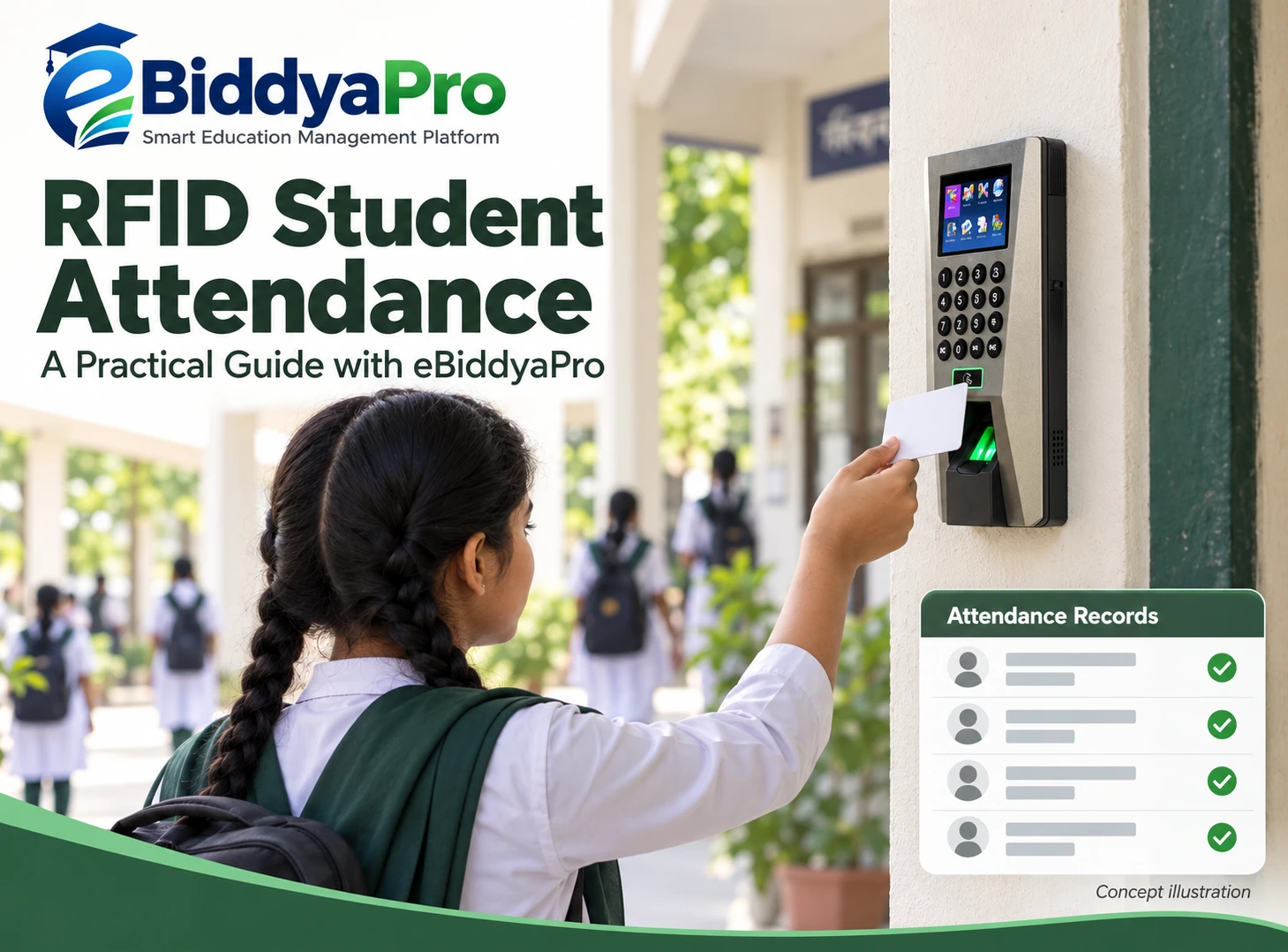
RFID smart card-based student attendance offers a way to capture attendance events electronically. Students present assigned cards to compatible readers, creating transactions that an integrated system can associate with their identities. However, a successful solution requires more than purchasing readers and distributing cards. Schools need accurate student records, appropriate attendance rules, and a dependable connection between hardware and software.
eBiddyaPro is positioned by its provider as a school management platform covering student administration, attendance, fees, examinations, and centralized reporting. This makes attendance a relevant part of the wider institutional workflow.
An important distinction applies throughout this guide: eBiddyaPro’s published evaluation guidance states that RFID integration, biometric devices, mobile attendance entry, and guardian alerts require separate verification. The following sections explain how schools can plan an RFID attendance workflow around eBiddyaPro, subject to confirmation of the proposed integration and package.
What Is RFID Smart Card-Based Student Attendance?
RFID stands for Radio Frequency Identification. In a typical card-based attendance arrangement, a reader detects a compatible card and captures its identifier. Software then associates that identifier with an enrolled student and records the relevant attendance event.
Depending on the hardware, students may need to bring their cards very close to the reader. Schools should distinguish this deliberate card-presentation process from long-range systems that detect credentials at a distance.
The card, reader, connection, and software each perform different functions. A reader recognizing a card does not automatically establish that the student’s attendance has been correctly recorded in the school’s administrative system.
Why Bangladesh Schools Should Consider the Complete Workflow
A school in Dhaka may operate morning and afternoon shifts, while a district institution may have limited technical support. A college or madrasah may need different attendance arrangements for different programs.
These examples show why schools should evaluate RFID attendance against their own operating conditions. The relevant question is whether the proposed arrangement can produce useful, trustworthy information without creating additional administrative complexity.
An eBiddyaPro evaluation should therefore begin with the institution’s actual attendance problems. Schools may want to reduce repeated data entry, obtain clearer class summaries, or investigate recurring absence more consistently. Each objective should be tested through a realistic demonstration.
How RFID Fits into an eBiddyaPro-Based School Environment
Attendance information becomes more useful when it relates to the same student identity used for other school activities. A student should not have unrelated identities in admission records, attendance files, and academic reports.
eBiddyaPro’s provider describes admission, student information, attendance, academic management, examinations, fees, and reporting as solution areas. The practical objective is to keep attendance connected with that wider administrative context.
For a proposed RFID implementation, ask the team to demonstrate the complete journey: identify a student, associate a credential, record a transaction through the chosen reader, review the attendance result, and produce the required report.
Preparing Accurate Student Records
Before introducing cards, schools should review their student register. Duplicate profiles, inconsistent names, and outdated class assignments can undermine an otherwise functional attendance system.
A stable institutional student ID should remain the main identity reference. Class roll numbers should be treated separately because they may change when students move between sections or academic years.
For example, a learner promoted from Class Seven to Class Eight should retain continuity in their historical records. During the eBiddyaPro demonstration, test how attendance remains associated with that student after a class change. Confirm whether the available configuration supports the school’s intended record structure.
Choosing Compatible Cards and Readers
RFID cards and readers are not universally interchangeable. Card technology, supported frequency, credential format, and communication arrangements must align.
ZKTeco’s CR100 documentation, for example, distinguishes 125 kHz proximity technology from 13.56 MHz smart card technology. This illustrates why a purchase decision must examine technical compatibility rather than relying on the general label “RFID.” It does not establish compatibility between that product and eBiddyaPro.
Schools should obtain written confirmation of the proposed reader model, card specification, and integration method. Testing a real card against the intended software workflow is more informative than viewing a reader demonstration alone.
Issuing Cards and Maintaining Student Associations
Card distribution should follow a controlled administrative process. Staff should verify the student’s identity before assigning a credential and confirm the association with a sample attendance transaction.
A card number is an attendance credential, not a replacement for the student’s institutional identity. Keeping those concepts separate makes replacement easier when a card is lost or damaged.
Schools should also decide who may issue, replace, or deactivate cards. These responsibilities should be reflected in the agreed eBiddyaPro implementation scope. Clear ownership helps prevent accidental reassignment and reduces disputes when an attendance event appears under the wrong student.
Planning Readers Around Student Movement
Reader placement affects both usability and arrival flow. A school should observe where students enter, how they queue, and whether different shifts use the same entrance.
Readers should be accessible to the intended age groups and positioned where staff can provide assistance without obstructing movement. Outdoor installations require suitable equipment and protection for the actual environment.
For example, a school with two entrances should test whether both locations can contribute records to the proposed attendance arrangement. It should also establish how staff respond when one entrance experiences a technical problem during a busy arrival period.
Understanding Gate Attendance and Classroom Attendance
A card presented at the school entrance provides evidence of a credential interaction at that location and time. It does not prove attendance in every lesson.
Schools should decide whether their objective is daily campus attendance, classroom attendance, or both. These represent different operational requirements and may need different entry methods.
An eBiddyaPro implementation should make the meaning of each attendance record clear. Teachers may still need to confirm classroom participation, especially where students change rooms or follow different subject combinations. Reports should avoid presenting a gate transaction as evidence of uninterrupted participation throughout the school day.
Setting Attendance Rules for Classes and Shifts
The same arrival time can have different meanings for students assigned to different shifts. A morning student arriving at noon and an afternoon student arriving at noon should not automatically receive the same status.
Before implementation, schools should define arrival windows, late thresholds, and any rules for approved exceptions. The software team should then demonstrate how those requirements would operate in the proposed configuration.
Special timetables also deserve attention. Examination days, shortened schedules, and institutional events may require temporary arrangements. Testing these cases helps administrators determine whether the proposed workflow can remain consistent throughout the academic year.
Confirming Synchronization and Offline Recovery
Schools should distinguish a successful card read from successful delivery of the resulting information. A reader may respond to a credential while the connection to the central system is unavailable.
The implementation discussion should cover expected update times, local transaction storage, recovery after interruption, and the handling of repeated records. None of these behaviors should be assumed solely because a device supports networking.
A practical acceptance test can temporarily disconnect a reader, capture approved sample events, and reconnect it. Staff should then compare the recovered information with the original transactions and verify the final attendance result in the proposed eBiddyaPro workflow.
Supporting Students Who Forget or Lose Cards
Students should have a clear alternative when they forget a card or experience a failed read. A missing credential should not automatically become an incorrect absence.
Schools can establish a supervised verification process, followed by an authorized attendance entry or correction through the available method. The exact process should be agreed during configuration.
For lost cards, staff should record the replacement and confirm whether the old credential can be disabled across the relevant devices. Replacement must preserve the student’s historical attendance. This scenario should be demonstrated before the institution depends on the system for daily operations.
Reducing Proxy Attendance
RFID records the use of a credential, so a student may present another person’s card unless additional supervision or verification is used. Card-based attendance should therefore not be promoted as inherently preventing proxy attendance.
A recent RFID attendance research prototype explicitly identifies card transfer as a limitation of RFID alone. Its experimental findings should not be treated as evidence about eBiddyaPro, but the underlying limitation is relevant when planning school procedures.
Visible student photographs on issued cards, supervised presentation, and teacher confirmation can support accountability. Schools should choose proportionate measures that fit their daily environment.
Making Attendance Reports Useful
A useful report should help staff answer an operational question. A class teacher may need an individual student’s attendance history, while an administrator may need a summary for a particular period.
During evaluation, request reports using realistic sample information. Include a late arrival, approved absence, forgotten card, and corrected record so that staff can assess how each case appears.
Schools should also establish how attendance percentages are calculated. Holidays, non-teaching days, enrollment dates, and approved arrangements can affect the denominator. Confirm the available reporting fields and calculation rules rather than assuming that a general attendance summary meets every institutional requirement.
Communicating with Guardians Responsibly
Attendance information can support timely conversations with guardians, but communication should follow verification. A failed reader connection should not trigger an unexplained accusation of absence.
If a school wants automatic notifications, it should confirm whether the proposed eBiddyaPro package supports them, which channel is used, and what additional charges apply. Message timing and correction procedures also need agreement.
Contact information should be reviewed regularly. Schools should define the authorized recipient and decide how to handle changed numbers or family arrangements. A carefully managed communication process helps make attendance information useful without creating unnecessary confusion.
Protecting Student Information
RFID attendance creates records about children’s movements and school participation. Institutions should limit access according to responsibility and collect only information needed for the agreed purpose.
The issued card should not expose unnecessary personal details. Attendance exports should be shared through controlled channels, and staff should understand how to respond to requests for corrections.
Ask the provider about access controls, backups, restoration, retention, and data export arrangements. Also confirm where credential associations and transaction records are stored. These questions belong in the implementation discussion because using a digital platform does not, by itself, establish appropriate information handling.
Budgeting and Piloting the eBiddyaPro Arrangement
The project budget should cover the complete operating arrangement, including readers, cards, installation, connectivity, software, integration, training, support, and replacements. Messaging and customization may introduce separate costs.
Begin with a representative pilot rather than immediately replacing every attendance process. Include ordinary arrivals, repeated card presentations, lost-card replacement, changed class assignments, and temporary connection failures.
Measure practical outcomes such as queue time, unresolved records, staff effort, and correction turnaround. Expand only after the school understands the results. This gives administrators a clearer basis for deciding how an RFID arrangement should support their eBiddyaPro environment.
Frequently Asked Questions
What is an RFID smart card attendance system?
It captures a compatible card identifier when the card is presented to a reader. Integrated software then associates the transaction with a student and interprets it according to the school’s attendance arrangements.
Does eBiddyaPro include RFID integration in every package?
Schools should not assume that it does. The provider’s guidance requires separate verification of RFID capabilities. Confirm the selected package, supported hardware, integration scope, and applicable charges before purchase.
Why should attendance connect with student records?
A shared student identity helps staff relate attendance to the correct learner, class, and academic period. It can also reduce confusion caused by separate spreadsheets or inconsistent names across administrative records.
Can an existing student ID card be used?
Possibly, if its RFID technology matches the proposed reader and integration requirements. A printed identification card may have no electronic credential, so existing cards should be physically tested before planning their continued use.
Are all RFID cards technically the same?
No. Cards differ in technology, frequency, credential format, and security capabilities. Compatibility must be confirmed between the card and reader, followed by verification of the complete software connection.
Must students physically touch the reader?
Not necessarily. Many contactless systems read cards held close to the reader. The required distance depends on the hardware and card, so schools should demonstrate the intended presentation method during training.
Can RFID identify students automatically from far away?
Some technologies support longer reading ranges, but a normal close-presentation reader should not be assumed to do so. Long-range detection requires a separate technical and operational evaluation.
Does a card scan prove classroom attendance?
No. It establishes a credential interaction at a particular reader. Classroom attendance requires an appropriate confirmation method, especially when the school needs period-wise participation rather than daily entrance information.
Can one student present another student’s card?
Yes, unless supervision or additional verification prevents it. RFID alone does not establish the identity of the person presenting the credential. Schools should explain the rules and use proportionate checks.
What happens if a student forgets their card?
The school should use a supervised alternative and record attendance through an authorized method. Staff should verify the student’s identity and avoid treating a forgotten credential as automatic absence.
How should a lost card be replaced?
Confirm the student’s identity, issue the new credential, and verify that it reaches the correct record. The old credential should be disabled where supported, while previous attendance remains associated with the student.
Can RFID attendance work during an internet interruption?
That depends on the reader’s storage and the integration’s recovery behavior. Test the actual arrangement to establish whether transactions are retained and how they reach the central system after reconnection.
Are attendance updates always immediate?
No unconditional timing promise should be assumed. Delivery can depend on connectivity and configuration. Schools should agree on expected update times and a method for identifying delayed information.
Can a school use several readers?
A multiple-reader arrangement may be possible, subject to the proposed integration. Test whether transactions retain the correct student association and whether repeated use across entrances produces appropriate attendance results.
How should morning and afternoon shifts be handled?
Students must be associated with the correct schedule. The school should test shift-specific arrival windows and late rules so that the same timestamp is interpreted appropriately for different groups.
Can teachers correct attendance errors?
This depends on the configured permissions and available workflow. Schools should define who can request, review, and finalize corrections, then verify those responsibilities in the eBiddyaPro demonstration.
Can guardians receive attendance messages?
This must be confirmed separately. Ask which communication channels are supported, when messages are sent, how incorrect messages are addressed, and whether messaging services require additional fees.
What reports should a school request?
Start with the questions staff regularly need to answer. These may involve individual histories, class summaries, or period comparisons. Test sample outputs and confirm the available filters, fields, calculations, and export formats.
How should attendance percentages be calculated?
The school must define the eligible teaching days and relevant exceptions. Enrollment dates, holidays, and approved arrangements can affect the result. Request a worked example using the institution’s own policy.
Can cards remain valid after student promotion?
They may remain usable if the credential stays associated with a stable student identity. Test promotion and section changes to confirm that new attendance uses current assignments while preserving historical context.
Does RFID attendance require fingerprint data?
A card-only workflow does not require fingerprint enrollment for card recognition. Schools should nevertheless confirm the complete proposed setup and ensure no additional biometric processing is introduced without a clear purpose.
Is RFID suitable for younger students?
Suitability depends on usability and supervision. Younger learners may need help carrying and presenting cards. Reader height, arrival routines, and alternatives for forgotten cards should be included in the pilot.
How can a school judge whether the project is worthwhile?
Compare the pilot with the existing process. Consider staff time, missing records, correction effort, queue conditions, and report usefulness. Avoid relying on unsupported promises of perfect accuracy or guaranteed savings.
How can schools begin an RFID attendance project with eBiddyaPro?
Discuss student numbers, shifts, entrances, existing cards, hardware, and reporting needs with the team. Request a complete demonstration and written scope, then approve a pilot before committing to wider deployment.
Recent Post